
 how-to
How to Treat Scalp Inflammation and Buildup: 7 Steps
Table of Contents
- What Causes Scalp Inflammation and Buildup
- Signs of Scalp Buildup You Should Not Ignore
- What You'll Need Before You Start
- Step 1: Reset Your Wash Routine
- Step 2: Exfoliate Gently and Support the Scalp Barrier
- Step 3: How to Soothe Itchy Scalp Without Making It Worse
- Scalp Detox Benefits and What a Professional Session Adds
- Microscopy Scalp Analysis: Seeing What Your Scalp Is Doing
- Frequently Asked Questions
Last Updated: September 30, 2026
What Causes Scalp Inflammation and Buildup
Knowing how to treat scalp inflammation and buildup starts here: it happens when oil, dead skin cells, and styling product collect faster than your wash routine can clear them. The result is an irritated scalp that feels tight, itchy, or heavy at the roots.
Knowing how to treat scalp inflammation and buildup starts with knowing what created it. At L'Elite Hair & More Beauty Studio, we see the same handful of causes again and again.
The most common drivers:
- Skipping washes or washing too often
- Heavy oils, butters, and dry shampoo left on the scalp
- Harsh sulfates that strip the scalp barrier
- Tight braids, weaves, or wigs that trap sweat
- Stress, hormonal shifts, and some medications
- Dry indoor air and hard water minerals
Some of these you control. Others you do not. The American Academy of Dermatology notes that scalp irritation has many possible triggers, so a single fix rarely solves everything.
That is why a reset routine beats a random product swap.
Signs of Scalp Buildup You Should Not Ignore
The clearest signs of scalp buildup are flakes that look waxy rather than dry, a greasy film at the roots, and itching that gets worse a day or two after washing. If your scalp feels coated no matter what you use, buildup is likely the issue.
Watch for these signals:
- White or yellow flakes that cling to the scalp
- A waxy or greasy feel right at the part line
- Itching, tingling, or a tight, tender scalp
- Odor even after a fresh wash
- Thinning at the part or hairline
- Bumps, scabs, or tender spots
One sign alone is easy to dismiss. Three or more together usually means the scalp needs real help, not another rinse.
What You'll Need Before You Start
Before you change anything, gather a few basics. This keeps you from buying five products that all do the same job.
What you'll need:
- A gentle, sulfate-free shampoo
- A scalp brush with soft silicone bristles
- A lightweight scalp serum or herbal oil
- A wide-tooth comb
- A clean towel and a few minutes of quiet
Time needed: about 20 minutes per session, twice a week.
Difficulty: easy to moderate.
If your scalp is raw, bleeding, or oozing, stop here and see a dermatologist first. No at-home routine should go on broken skin.
Step 1: Reset Your Wash Routine
Start by washing your scalp, not your hair. The scalp is skin, and it needs the same gentle, consistent care you give your face.
Here is the reset:
- Wet hair with lukewarm water, never hot.
- Apply shampoo directly to the scalp in small dots.
- Massage with fingertips for 60 seconds.
- Rinse until the water runs clear.
- Repeat only if you used heavy product.
Wash two to three times a week if you have an oily scalp. Stretch to once a week if your scalp runs dry. The goal is a clean scalp that does not feel stripped.
A common mistake is piling shampoo on the ends. Ends do not need cleansing, and the extra product just weighs hair down.
Step 2: Exfoliate Gently and Support the Scalp Barrier
Exfoliation removes the layer of dead skin and product that shampoo alone cannot lift. Do it gently, and do it less often than you think.
Use a soft silicone scalp brush in slow circles for two to three minutes. Work in sections, and keep the pressure light. Once a week is plenty for most people.
After exfoliating, support the barrier:
- Apply a lightweight serum or a few drops of herbal oil
- Focus on the scalp, not the hair shaft
- Leave it on for 10 to 15 minutes
- Rinse with lukewarm water
Ingredients that tend to suit sensitive scalps include tea tree, peppermint, aloe, and chamomile. Patch test anything new on your inner arm first.
If your scalp burns or turns red, rinse right away and skip that product next time.
Step 3: How to Soothe Itchy Scalp Without Making It Worse
To soothe an itchy scalp, stop the things that trigger the itch before you add anything new. Most itch gets worse from heat, friction, and harsh products, not from a lack of treatments.
Try these first:
- Switch to fragrance-free or low-fragrance products
- Skip dry shampoo for two weeks
- Loosen tight styles and let the scalp breathe
- Wash pillowcases twice a week
- Use cool or lukewarm water only
- Keep a log of what you used before the itch started
If itch comes with redness, swelling, or patches of hair loss, that is a signal to see a dermatologist. A scalp wellness professional can support the scalp environment, but a medical concern needs a medical evaluation.
Scalp Detox Benefits and What a Professional Session Adds
The main scalp detox benefits are a cleaner scalp environment, less product residue, and more comfortable skin between washes. Think of it as a deep reset, not a cure.
A professional session adds tools you cannot replicate at home:
- Steam and warm water to soften buildup
- Trained hands to read the scalp as they work
- Custom herbal blends matched to your scalp type
- LED hair therapy to support the scalp environment
- A calm, unhurried setting that lowers stress
L'Elite Hair & More Beauty Studio offers Deep Scalp Detox, Japanese Head Spa, and Indian Head Massage as part of a scalp wellness plan. Each one supports scalp wellness and healthy-looking hair.
| Service | Best For | Session Focus |
|---|---|---|
| Deep Scalp Detox | Heavy buildup, oily roots | Clearing residue and oil |
| Japanese Head Spa | Tension, dull scalp feel | Steam, cleanse, relaxation |
| Indian Head Massage | Stress, tight scalp | Circulation and calm |
| LED Hair Therapy | Thinning, weak-looking hair | Scalp environment support |
For guidance on scalp conditions, the American Academy of Dermatology scalp resource is a solid starting point.
Microscopy Scalp Analysis: Seeing What Your Scalp Is Doing
A microscopy scalp analysis uses a handheld scope to magnify the scalp so you can see buildup, flaking, redness, and follicle activity up close. It turns guesswork into a clear picture.
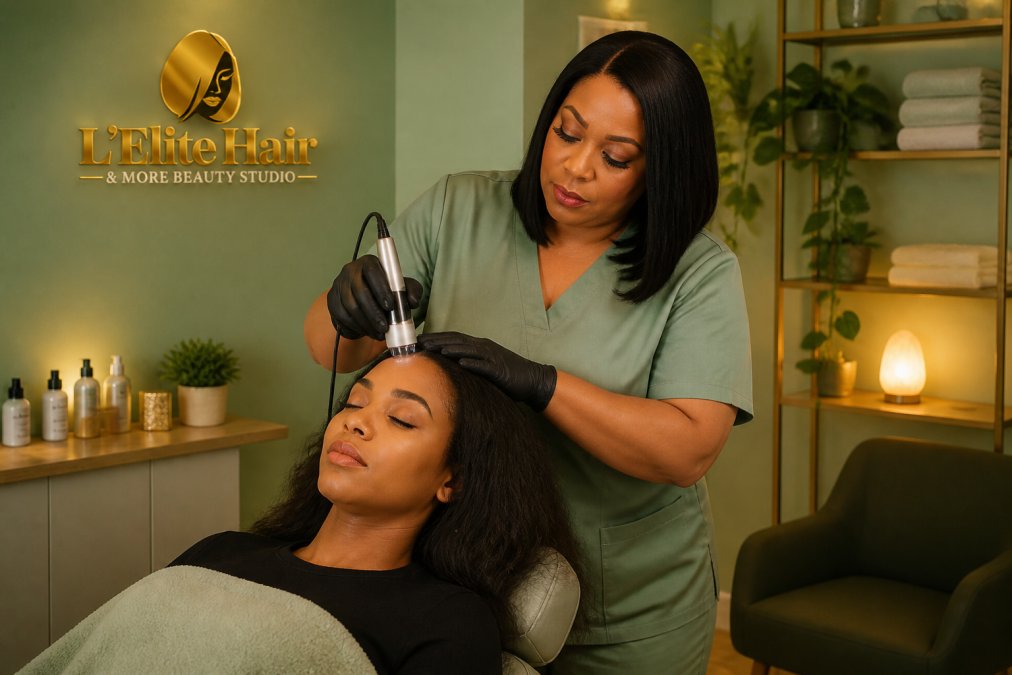
Here is what it usually shows:
- How much product and oil sits on the scalp
- Whether flakes are dry or oily
- Where the scalp looks irritated
- How dense the hair is along the part
- Whether follicles look active or quiet
This is not a diagnosis. It is education. You leave knowing what your scalp is doing and what to change.
Linda E. at L'Elite Hair & More Beauty Studio is a licensed cosmetologist and certified trichologist with decades of experience. She uses microscopy scalp analysis to build a personalized plan and refers clients to a dermatologist when a concern falls outside scalp wellness care.
Scalp inflammation and buildup rarely fix themselves, and guessing at products often makes things worse. A clear routine, gentle exfoliation, and a real look at your scalp can turn things around in weeks. L'Elite Hair & More Beauty Studio offers Microscopy Scalp Analysis, Scalp Wellness Consultations, Deep Scalp Detox, and customized herbal scalp treatments to build a plan that fits your scalp. Book through Vagaro or call the studio to schedule your scalp wellness consultation and start with a clear picture of what your scalp actually needs.
Frequently Asked Questions
What are the common signs of scalp inflammation and buildup?
Look for persistent itching, flaking that looks like dandruff but does not clear with regular shampoo, redness along the hairline, a waxy or greasy film at the roots, and hair that feels coated even right after washing. Some people notice a faint odor or small bumps near the scalp edge. Buildup often develops slowly, so many clients only realize how much had collected after a professional scalp analysis or detox.
Can scalp buildup lead to hair thinning or shedding?
Buildup itself does not directly cause hair loss, but it can clog follicles, trap oils and dead skin, and create an environment where the scalp stays irritated. That irritation may contribute to shedding and can make hair look thinner at the roots. If you are noticing sudden or unexplained shedding, it is worth having a professional scalp analysis and speaking with a dermatologist to rule out medical causes.
How does a professional scalp analysis help identify inflammation?
A microscopy scalp analysis uses a magnified scope to look at the scalp surface, follicles, and areas of redness or flaking that are hard to see in a mirror. It helps a trained professional tell the difference between product buildup, dry flaking, and irritation that may need medical attention. This is why many clients find a scalp analysis useful before starting a new home routine.
When should you see a dermatologist for scalp concerns?
See a dermatologist if you have open sores, crusting, pus, severe pain, sudden patchy hair loss, or inflammation that does not improve after several weeks of gentle home care. A dermatologist can evaluate for conditions like seborrheic dermatitis, psoriasis, or fungal infections. Professional scalp services support scalp wellness, but they do not diagnose or treat medical conditions.