
 blog
blog
Professional Scalp Treatment vs Home Care: Which Works Best
Table of Contents
- What Professional Scalp Treatment Does
- Building an Effective At-Home Scalp Care Routine
- The Role of Scalp Analysis in Treatment Planning
- What a Scalp Detox Treatment Does
- How Often Should You Get a Scalp Treatment
- When to See a Professional About Scalp Concerns
- Combining Professional Care with Home Maintenance
- Frequently Asked Questions
Last Updated: October 5, 2026
What Professional Scalp Treatment Does
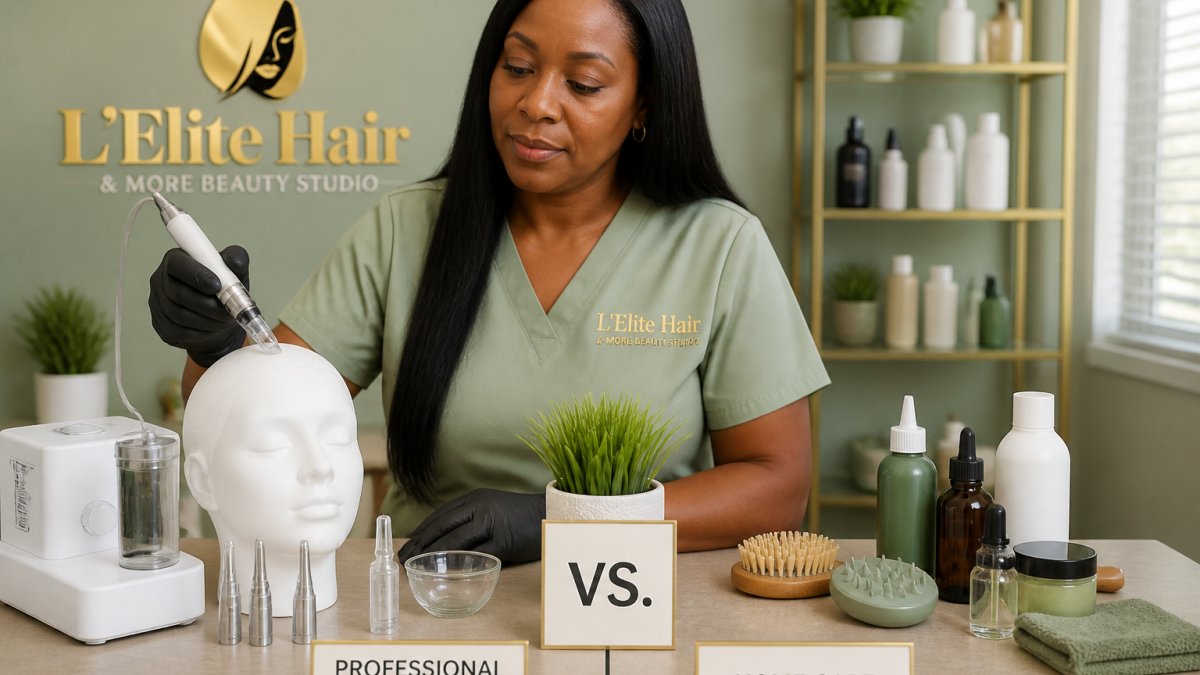
Professional scalp treatment is a diagnostic and therapeutic service that addresses scalp conditions and imbalances at-home routines often cannot reach, using specialized assessment, targeted interventions, and personalized recommendations, making professional scalp treatment vs home care a strategic partnership rather than an either-or choice.
At L'Elite Hair & More Beauty Studio, professional scalp treatment begins with understanding what's happening beneath the surface.
Microscopy Scalp Analysis and Diagnosis
A microscopy scalp analysis uses specialized magnification equipment to identify buildup, inflammation, dryness, sensitivity, product accumulation, and other conditions affecting hair health, critical because most scalp problems are invisible to the naked eye.
Microscopy reveals what the mirror can't, sebum blocking follicles, inflammation from product residue, a dehydrated barrier, and determines whether your scalp needs deep cleansing, soothing, moisture restoration, or a combination.
Deep Cleansing and Product Buildup Removal
Product buildup is one of the most common scalp problems, yet it's difficult to address at home. Over time, silicones, polymers, oils, and styling products create a barrier that traps moisture and disrupts the scalp's natural protective functions, leading to dryness, itching, flaking, and even hair thinning.
Professional deep cleansing removes stubborn buildup using thorough cleansing, gentle exfoliation, and extraction methods home products cannot replicate. Once removed, your scalp can breathe, absorb treatments more effectively, and return to a healthier state.
Specialized Treatments for Irritation and Sensitivity
When your scalp is irritated, inflamed, or sensitive, standard products often make things worse. L'Elite Hair & More Beauty Studio offers customized herbal scalp treatments, Japanese Head Spa services, and Indian Head Massage, each designed to calm irritation and support scalp wellness.
These treatments combine proper technique, appropriate product selection, and skilled touch, a professional knows when a scalp needs gentle soothing versus active treatment.
Building an Effective At-Home Scalp Care Routine
An at-home scalp care routine maintains scalp health between professional treatments. The key is consistency, appropriate products, and understanding the difference between hair care and scalp care.
Most people wash their hair. Few people actually care for their scalp. Hair care focuses on shine, softness, and manageability.
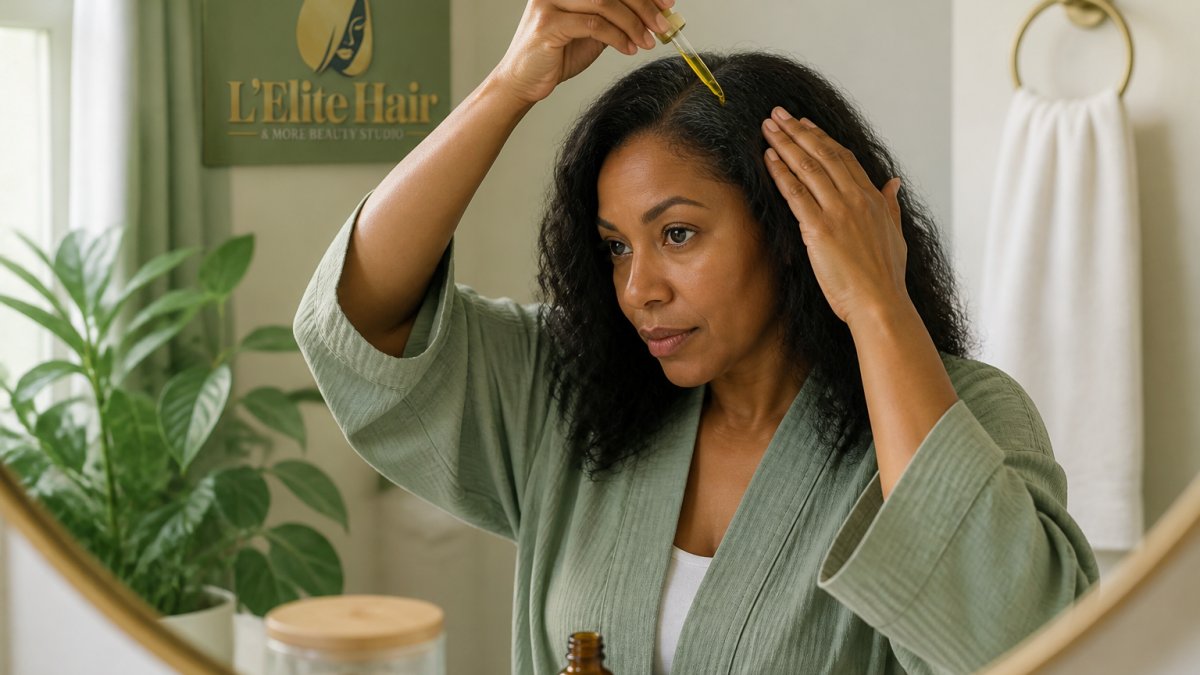
Daily Cleansing and Scalp Massage
Your daily routine should include gentle cleansing and scalp stimulation. Use a scalp-focused cleanser rather than a standard shampoo, and massage your scalp with your fingertips in gentle circular motions to stimulate blood flow and remove surface buildup.
Scalp massage is simple but powerful. Use your fingertips, not your nails, applying gentle pressure in small circles across your entire scalp for at least two minutes during cleansing.
Weekly Treatments and Maintenance
Once or twice weekly, add a targeted scalp treatment, a mask, exfoliating treatment, or nourishing oil. If your scalp is dry, choose a hydrating treatment; if oily or congested, choose a clarifying one.
Apply it directly to your scalp, not just your hair, and leave it on for the recommended time. This weekly step maintains improvements from professional care and prevents problems from returning.
The Role of Scalp Analysis in Treatment Planning
Scalp analysis determines whether your problem is dryness, sensitivity, buildup, inflammation, or a combination. Without it, you're guessing. At-home analysis is limited to what you can see and feel; professional microscopy reveals what's actually happening.
A professional scalp analysis guides your entire treatment plan, identifying specific concerns, ruling out conditions requiring medical evaluation, and providing a roadmap for professional treatments and at-home maintenance.
What a Scalp Detox Treatment Does
A scalp detox treatment is a deep cleansing and clarifying service that removes accumulated buildup, product residue, and impurities. "Detox" here means clearing away barriers and restoring the scalp's natural balance, not medical detoxification.
How Buildup Affects Scalp Health and Hair Growth
Product buildup creates a barrier that interferes with moisture balance, air circulation, and the scalp's natural protective functions. It can trap bacteria and fungi, leading to irritation, itching, and flaking, and over time can contribute to hair thinning.
When buildup is removed through professional detox treatment, the scalp can function normally again, the protective barrier restores itself, moisture balance improves, and irritation typically subsides. Many people notice healthier-feeling hair afterward.
Professional Detox Versus At-Home Methods
At-home clarifying shampoos reduce surface buildup but cannot address deeply accumulated residue. Professional scalp detox uses specialized techniques, targeted products, and sometimes gentle exfoliation or extraction to thoroughly clear the scalp.
It's like washing your face with cleanser versus getting a professional facial: one maintains, the other transforms. At-home methods are valuable between professional treatments but are not a substitute for professional-grade cleansing when significant buildup exists.
How Often Should You Get a Scalp Treatment
There is no single correct schedule. The right cadence depends on what your scalp is doing now, what you do between visits, and how it responds to the first session. Frequency generally falls into three patterns, and your microscopy scalp analysis determines which fits you.
A Practical Frequency Framework
Active concern (buildup, flaking, irritation, sensitivity, or noticeable shedding). A common starting pattern is every 4 to 6 weeks until the scalp stabilizes, then spacing visits further apart.
Maintenance after improvement. Once the scalp environment is balanced, many clients move to every 8 to 12 weeks.
General scalp wellness. If your scalp is relatively calm and you want to support scalp wellness and healthy-looking hair, a seasonal rhythm, roughly two to four professional visits per year, is a reasonable baseline.
What Actually Changes Your Frequency
Several factors shift the schedule:
- Scalp type. Oily scalps accumulate sebum and residue faster, often meaning shorter intervals. Dry or reactive scalps may need gentler, more spaced-out sessions so the barrier isn't over-stripped.
- Product use. Heavy dry shampoo, leave-in conditioner, oil, gel, or silicone use accelerates buildup. Daily stylers may need professional cleansing more often than those who air-dry and use minimal product.
- Chemical and heat services. Relaxers, color, and frequent heat styling can leave the scalp sensitive. Time professional scalp care around, not immediately after, chemical services, and ask your practitioner about spacing.
Realistic Outcome Timelines
It helps to separate what professional scalp care can realistically do from what it cannot.
- Cosmetic and comfort improvements, less itching, less flaking, a cleaner-feeling scalp, softer hair, are often noticeable within one to two sessions.
- Scalp environment changes, a calmer, more balanced scalp that holds its condition longer, build over several sessions and depend heavily on your at-home routine.
- Hair density and growth are a different category. Professional scalp care supports a healthy scalp environment, which supports healthy-looking hair, but it does not treat, cure, or reverse medical hair loss. Any change in hair density should be evaluated by a licensed healthcare professional or dermatologist.
Adjusting Frequency Without Over-Treating
More is not automatically better. Over-cleansing or over-exfoliating a sensitive scalp can strip the barrier and create the irritation you're trying to resolve.
The goal is a rhythm your scalp can sustain.
If you're unsure where to start, a scalp wellness consultation is the simplest way to get a personalized recommendation.
When to See a Professional About Scalp Concerns
Not every scalp concern belongs in the same category, and one of the most useful things a professional can do is help you sort out which type you're dealing with. Scalp concerns broadly fall into three buckets: cosmetic issues that respond well to professional scalp care, issues needing a trichologist's or dermatologist's evaluation, and issues needing medical treatment.
Signs That Home Care Isn't Enough
If you've been consistent with a quality at-home routine for 4 to 6 weeks and still experience itching, flaking, dryness, sensitivity, or excessive shedding, that persistence is a signal.
Sudden changes deserve attention regardless of duration. New irritation, a sudden increase in shedding, or unexplained flaking appearing over days rather than weeks differs from a slow, gradual pattern.
Cosmetic Concerns vs. Concerns That Need Medical Assessment
This distinction matters most, so it's worth stating plainly.
Concerns that generally respond well to professional scalp care:
- Product and sebum buildup that leaves the scalp feeling congested or coated
- Dryness and flaking related to a compromised scalp barrier
- Sensitivity and irritation from product residue or environmental factors
Concerns that warrant evaluation by a licensed healthcare professional or dermatologist:
- Persistent itching, burning, or pain that does not respond to basic care
- Signs of infection, oozing, crusting, weeping, swelling, or unusual odor
- Sudden or unexplained hair loss, or hair loss in patches
A professional trichologist or scalp wellness practitioner can help determine which category your concern falls into. If it falls outside the scope of cosmetic and scalp-wellness services, the next step is a referral to a licensed healthcare professional or dermatologist, not a dismissal, but the right care for the right concern.
Product Safety and Contraindications
Professional scalp care is generally gentle but not risk-free for everyone. A few precautions are worth knowing before any treatment, professional or at-home.
- Patch testing. With any new product, especially actives, essential oils, or exfoliating acids, test a small area first and wait 24 to 48 hours. This applies to at-home products and new professional treatments.
- Ingredient sensitivities. Tell your practitioner about known allergies or sensitivities, fragrances, preservatives, botanicals, or specific actives. Professional products are not automatically hypoallergenic.
- Recently treated scalps. After a chemical service, color, relaxer, or medical procedure, the scalp may be more sensitive. Tell your practitioner what you had done and when.
How to Prepare for a Professional Evaluation
A little preparation makes a professional evaluation far more useful. Before your appointment, note:
- When the concern started and whether it was gradual or sudden
- What products you use on your scalp and hair, and how often
- Recent changes, new products, medications, diet, stress, or chemical services
This helps your practitioner connect the dots and makes any referral more productive, because you arrive with a timeline rather than a vague complaint.
If you're unsure which category your concern falls into, a scalp wellness consultation is a low-pressure way to find out. You'll get an honest assessment, education about what's happening, and a clear recommendation, including a referral when that's the right next step.
Combining Professional Care with Home Maintenance
The most effective approach combines professional scalp treatments with consistent at-home care, a partnership where professionals address underlying issues while you maintain scalp health between appointments.
Your professional treatment plan should always include at-home guidance: which products support your scalp health, how often to use them, and what techniques to practice daily.
If you're experiencing scalp concerns, buildup, dryness, sensitivity, or hair changes, a professional scalp analysis is the logical first step.
| Aspect | Professional Treatment | At-Home Care |
|---|---|---|
| Diagnostic capability | Microscopy analysis reveals hidden issues | Visual inspection only |
| Buildup removal | Deep cleansing using specialized techniques | Surface cleansing with regular products |
| Treatment intensity | Targeted, intensive interventions | Maintenance and support |
| Frequency | Monthly to quarterly for active concerns | Daily to weekly maintenance |
| Cost investment | Higher per session | Lower ongoing investment |
| Results timeline | Visible improvement within 1-2 sessions | Gradual improvement with consistency |
| Best for | Addressing existing problems | Maintaining scalp health |
| Scalp assessment | Professional guidance based on analysis | Self-evaluation and observation |
Frequently Asked Questions
Can at-home scalp care replace a professional scalp treatment?
At-home care is essential for maintaining scalp health between professional visits, but it has limits. Home routines address daily cleansing, moisture, and basic maintenance. Professional scalp treatments offer microscopy analysis, deep cleansing that removes stubborn buildup, specialized herbal or detox treatments, and personalized diagnosis of underlying scalp concerns. For most people, the best approach combines consistent home care with periodic professional treatments, especially if you're dealing with thinning hair, excessive shedding, or scalp sensitivity.
How often should you get a professional scalp treatment?
Frequency depends on your scalp condition and goals. People with healthy scalps may benefit from professional treatment every 4-8 weeks for maintenance and deep cleansing. Those with scalp buildup, irritation, dryness, or hair-loss concerns often see better results with monthly visits initially, then spacing them out as the scalp improves. Your professional can assess your scalp during analysis and recommend a schedule tailored to your specific needs.
What does a professional scalp analysis show?
Microscopy scalp analysis uses magnification to examine your scalp's actual condition, revealing buildup, inflammation, dryness, oiliness, product residue, and signs of sensitivity or irritation that the naked eye can't detect. This diagnosis guides treatment decisions and helps identify whether your concerns are cosmetic (dry, dull hair) or require deeper intervention (scalp inflammation, thinning). Analysis also helps rule out conditions that may need medical evaluation from a dermatologist.
When should you see a professional about scalp concerns?
Schedule a professional consultation if you experience sudden or unexplained shedding, persistent itching or burning, visible inflammation or flaking that doesn't improve with over-the-counter products, thinning hair, excessive buildup despite regular washing, or scalp sensitivity that makes styling difficult. If you're undergoing medical treatment (like chemotherapy) or experiencing significant stress-related hair loss, professional scalp wellness support combined with medical guidance can help. A professional can determine whether your concern is within the scope of scalp care or requires a dermatologist's evaluation.