
 ultimate-guide
Scalp Analysis Cost for Hair Thinning: 2026 Guide
Table of Contents
- What a Scalp Analysis Actually Involves
- Scalp Analysis Cost for Hair Thinning: What Drives the Price
- Microscopy Scalp Analysis: How It Works and Why It Matters
- What Happens During a Scalp Wellness Consultation
- When to See a Dermatologist for Hair Loss
- Holistic Hair Thinning Support After Your Analysis
- DIY vs. Professional Analysis: What You Can and Cannot Do at Home
- Conclusion
- Frequently Asked Questions
Last Updated: September 28, 2026
What a Scalp Analysis Actually Involves
Scalp analysis cost for hair thinning depends far more on who performs the analysis than on the analysis itself. A scalp analysis is a professional examination of the scalp and hair follicles that evaluates density, inflammation, sebum levels, and hair shaft condition to identify likely causes of thinning. At L'Elite Hair & More Beauty Studio, this work sits at the intersection of cosmetology, trichology, and scalp wellness education, so pricing rarely has one clean answer.
The confusion starts with language. Two very different services get called the same thing.
Clinical vs. Cosmetic Scalp Analysis
A clinical scalp analysis is diagnostic. It may involve a dermatological assessment, blood work, a scalp biopsy, or prescription treatment, and it is performed by a physician or dermatologist. A cosmetic scalp analysis is educational and observational, using tools like microscopy and hair density mapping to assess the scalp environment and support healthy-looking hair, but it does not diagnose disease.
That distinction drives everything about pricing. Clinical evaluation involves medical licensure, laboratory work, and insurance billing codes. Cosmetic analysis involves professional training, specialized equipment, and time. According to the American Academy of Dermatology's guidance on hair loss, persistent or sudden shedding warrants medical evaluation, which is a separate pathway from salon-based scalp wellness services.
Scalp Analysis Cost for Hair Thinning: What Drives the Price
Several variables move the number up or down.
- Provider type: A certified trichologist, a dermatologist, and a cosmetology studio each price differently because their scope of practice differs.
- Analysis depth: A quick visual check takes minutes; microscopy takes considerably longer.
- Session length: Consultations including patient history, scalp sensitivity review, and a written post-analysis roadmap cost more than a walk-in screening.
- Follow-up structure: Single-visit pricing versus a package with progress re-checks.
- Location and market: Metro overhead runs higher than in a smaller studio market.
Because L'Elite has not published a fixed price list, pricing depends on the type of analysis, the depth of the consultation, and whether follow-up visits are included. Call the studio at 239-319-0942 or check the booking page for current rates rather than relying on a number you saw elsewhere.
How to Judge Whether an Analysis Is Worth Its Price
Since no two studios publish the same menu, the more useful question is not "what does it cost" but "what does the price actually buy." Most scalp analyses fall into one of three tiers.
Tier 1, Complimentary or introductory screening. A short visual look at the scalp, often bundled with a service booking. Expect a quick density glance and a service suggestion, not magnification, written findings, or a plan you can follow for months. Fine as a first impression, but not a substitute for evaluation.
Tier 2, Paid professional scalp analysis. This is where microscopy scalp analysis and scalp wellness consultations typically sit.
Free vs. Paid Consultations
Free consultations exist, and they are not automatically bad. They are usually short, visual, and designed to introduce services, but they typically lack magnification, documentation, and a written plan you can act on later.
Insurance Coverage and Reimbursement
Most cosmetic scalp and hair services are not covered by insurance because they are elective. Clinical services differ: when hair loss is tied to a documented medical condition, a dermatologist visit and related testing may be partially covered under a standard health plan, subject to deductibles and network rules.
Microscopy Scalp Analysis: How It Works and Why It Matters
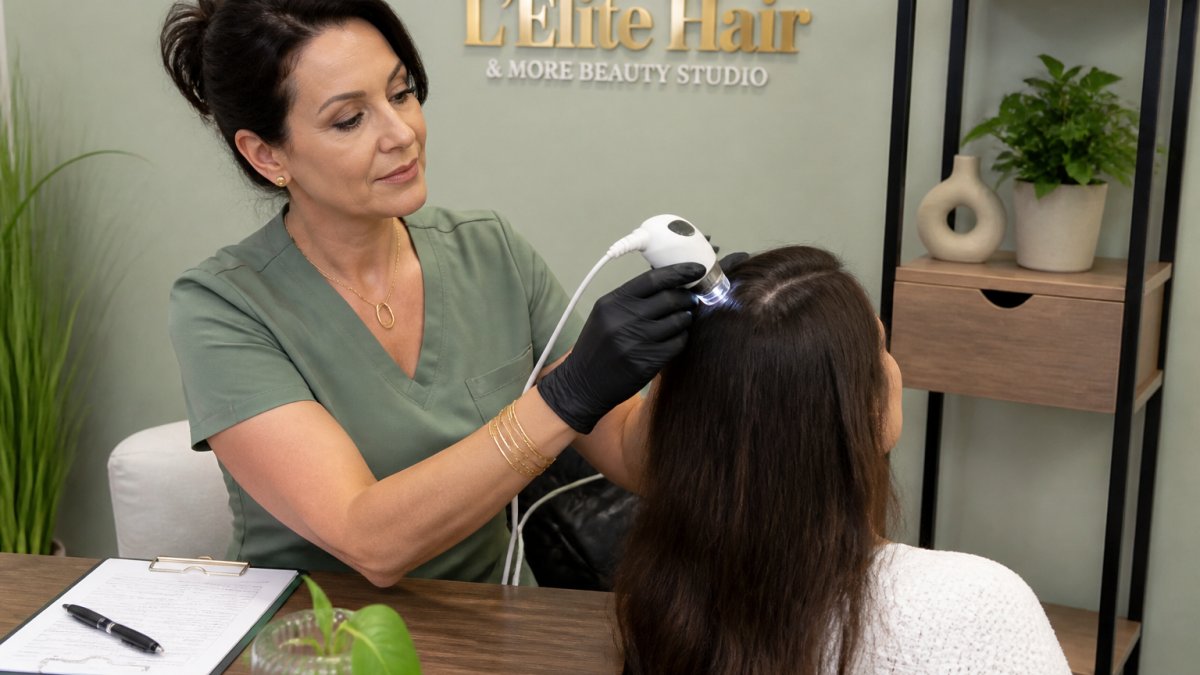
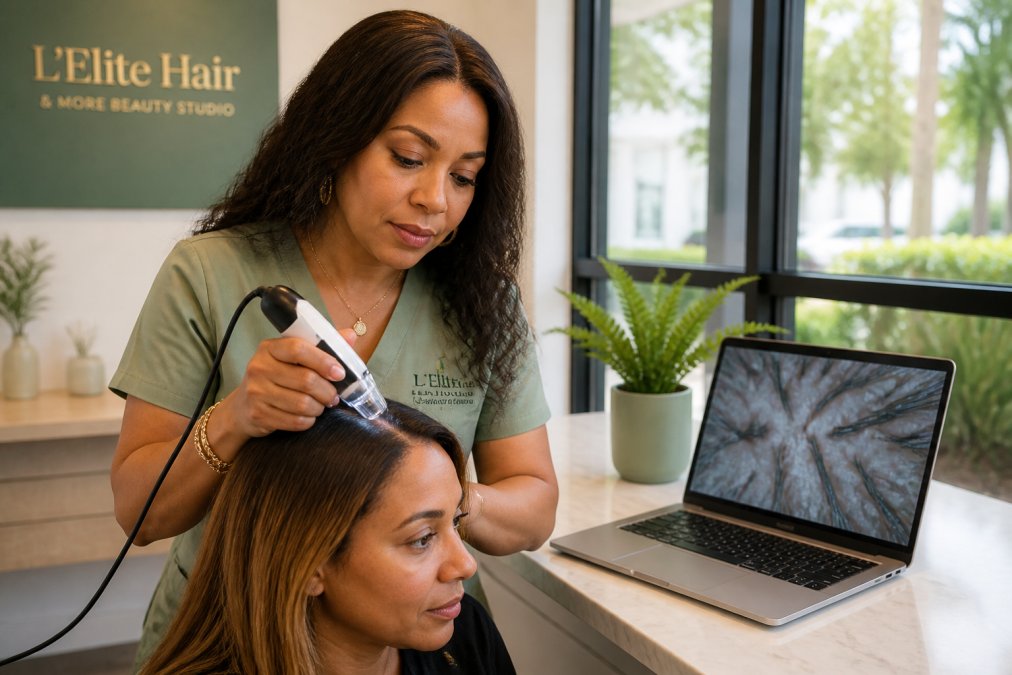
Microscopy scalp analysis uses a handheld digital microscope to magnify the scalp and hair at the follicle level, revealing buildup, redness, flaking, and variation in hair shaft diameter the naked eye misses. It is non-invasive, takes only minutes, and produces images you can see.
What Happens During a Scalp Wellness Consultation
A scalp wellness consultation follows a predictable arc.
- Patient history. Medications, recent stress, hormonal changes, styling habits, and family patterns.
- Visual and microscopic examination. Scalp sensitivity, flaking, follicular density, and hair shaft condition.
- Findings review. What was observed, in plain language, with images.
- Personalized plan. Service recommendations, at-home care, and realistic expectations.
- Referral, if needed. Anything requiring medical evaluation goes to a licensed healthcare professional.
Setup takes a few minutes, and the conversation is the point. Expect questions rather than a pitch.
What the Findings Usually Mean
Most consultations land in one of a handful of patterns, each pointing toward a different next step.
- Buildup and residue. Product, oil, or hard-water film on the scalp. Usually the most correctable finding, and often the fastest to improve with a deep scalp detox and a simplified routine.
- Visible inflammation or redness. The scalp looks irritated rather than simply dry. This calls for gentler products, less heat and tension, and sometimes a referral if it persists.
- Diffuse thinning without obvious scalp irritation. Density is lower than expected across the top or crown. Worth a medical conversation, since thyroid, iron, hormonal, and nutritional factors are common contributors only a physician can test for.
- Patchy or sharply defined loss. Not a cosmetic pattern; see a dermatologist promptly.
- Breakage rather than shedding. Hair is snapping along the shaft from heat, chemical, or tension damage. The follicle is fine; the fiber is not. Styling changes and strengthening services matter more here than scalp treatments.
Your Post-Analysis Roadmap
Week 1, Act on the easy wins. Swap out the products flagged during the consultation, remove tension styles, and reduce heat tool use. These changes cost nothing and often produce the first visible difference.
Questions Worth Asking Before You Book
A good consultation invites questions. These matter most:
- Will I see magnified images of my scalp?
- Will I leave with a written plan, or just verbal suggestions?
- What is included in the price, and what would be an add-on?
- At what point would you refer me to a dermatologist?
- How often should I come back for a re-check?
If a provider cannot answer these clearly, that tells you something useful before you spend anything.
When to See a Dermatologist for Hair Loss
Sudden, patchy, or rapid shedding needs a physician, not a salon. See a dermatologist when shedding is abrupt, when you notice smooth bald patches, when the scalp is painful, or when thinning accompanies fatigue, weight change, or other systemic symptoms.
Holistic Hair Thinning Support After Your Analysis
Once you have your findings, the work shifts from identification to maintenance. Holistic hair thinning support focuses on the scalp environment rather than a single product, and it works best as a routine.
- Deep scalp detox to address buildup without stripping the scalp.
- Customized herbal scalp treatments chosen for your scalp type and sensitivity.
- LED hair therapy as a supportive, non-invasive service.
- Gentle styling, including Silk Press and natural hair care, to limit tension and heat damage.
- Consistent re-checks so adjustments are based on images, not memory.
DIY vs. Professional Analysis: What You Can and Cannot Do at Home
At-home assessment has real limits, and knowing them saves money and frustration.
| Approach | What It Reveals | Best For | Limitation |
|---|---|---|---|
| At-home tracking | Shedding patterns, visible changes | Preparing for a consultation | No magnification or measurement |
| Cosmetic scalp analysis | Buildup, inflammation, density | Scalp wellness planning | Does not diagnose conditions |
| Clinical evaluation | Medical causes, lab results | Sudden or patchy loss | Higher cost, separate pathway |
Conclusion
The real challenge with scalp analysis cost for hair thinning is not finding a number. It is knowing which type of analysis you actually need, and what a fair price should include. A cheap screening that ends in a sales pitch costs more than it saves, and a medical evaluation you skipped can cost you months of correctable thinning.
Frequently Asked Questions
What happens during a professional scalp analysis?
A professional scalp analysis typically starts with a conversation about your hair history, shedding patterns, styling habits, and any medications or health conditions. The specialist then examines your scalp visually and often uses a handheld microscope to check follicular density, sebum levels, scalp inflammation, and hair shaft diameter. Some consultations include hair density mapping. You leave with personalized recommendations and, when needed, a referral to a dermatologist for further evaluation such as blood work or a scalp biopsy.
Is a scalp analysis necessary for hair thinning?
It is not always required, but it gives you a clearer starting point. Hair thinning has many triggers, including genetics, stress, hormonal shifts, nutritional gaps, and styling damage. A scalp analysis helps identify what is happening on your scalp so you can choose the right next step, whether that is a scalp wellness consultation, holistic hair thinning support, or a medical evaluation. Without an assessment, you may spend months on products that do not address your actual concern.
How does microscopy help in evaluating scalp health?
Microscopy scalp analysis magnifies the scalp and hair follicles far beyond what the naked eye can see. A trichologist can observe hair follicle health, sebum levels, scalp sensitivity, flaking, and early signs of thinning that are easy to miss otherwise. This non-invasive testing supports more accurate professional evaluation and helps build a targeted treatment plan. It does not replace a medical diagnosis, but it provides useful information that can guide both salon services and conversations with your doctor.
When should I see a dermatologist for hair thinning?
See a dermatologist if you notice sudden or unexplained shedding, patchy hair loss, scalp pain, redness, scaling, or thinning that continues despite consistent care. A dermatologist can order blood work, perform a clinical examination, and if needed conduct a scalp biopsy to check for conditions such as alopecia or thyroid-related concerns. A scalp analysis cost for hair thinning is often lower than medical testing, so many people start with a professional scalp evaluation and then follow up with a dermatologist when symptoms suggest a medical cause.