
 ultimate-guide
Telogen Effluvium: What It Is and How to Treat It
Table of Contents
- What Is Telogen Effluvium?
- Common Triggers Behind Stress-Induced Hair Loss
- How to Tell If Your Shedding Is Telogen Effluvium
- The Microscopy Scalp Analysis Benefits of Seeing Your Scalp Up Close
- How to Support Hair Growth After Shedding
- Scalp Wellness for Thinning Hair: Daily Habits That Help
- Telogen Effluvium vs. Androgenetic Alopecia: Why the Difference Matters
- The Emotional Side of Shedding and Where to Find Support
- Frequently Asked Questions
Last Updated: September 25, 2026
What Is Telogen Effluvium?
Telogen effluvium is a temporary, stress-induced form of hair shedding in which a large number of hair follicles shift out of the growing anagen phase and into the resting telogen phase at the same time. Roughly two to three months later, those hairs release and shed together. (Source: the American Academy of Dermatology)
Common Triggers Behind Stress-Induced Hair Loss
The most common triggers fall into a few predictable categories, and most people can identify at least one once they look at the two-to-three-month window before shedding started.
- Physical stress: surgery, high fever, serious illness, or major injury
- Emotional stress: grief, job loss, divorce, caregiving, or trauma
- Nutritional deficiency: low iron or ferritin levels, inadequate protein, or rapid weight loss
- Hormonal shifts: postpartum hair loss, thyroid dysfunction, or stopping hormonal medication
- Medications and treatments: certain prescriptions and medical treatments
How to Tell If Your Shedding Is Telogen Effluvium
Telogen effluvium shedding looks different from ordinary daily hair loss. The key markers are timing, pattern, and the absence of scalp scarring.
Signs That Point to a Reactive Process
- Shedding that started suddenly, roughly two to three months after a trigger
- Diffuse thinning across the whole scalp rather than one bald patch
- Noticeably more hair on pillows, in drains, and on brushes
- Hair that comes out easily when you run your fingers through it
- No itching, burning, or visible scalp inflammation
A useful benchmark: most people shed somewhere between 50 and 100 hairs a day, and those hairs come out gradually as part of the normal cycle (the American Academy of Dermatology). In telogen effluvium, that number climbs well above baseline and the shedding is clustered, handfuls in the shower, a dense nest in the brush, a pillow covered in strands.
How a Practitioner Actually Works Through the Diagnosis
Most cases are diagnosed by history and physical exam, not by a single test. A typical workup moves through a few steps:
- History. Your practitioner maps the shedding against the two-to-three-month window and asks about surgery, illness, fever, childbirth, weight loss, new medications, and major stressors.
- Visual scalp exam. Diffuse thinning with no bald patches, no scaling, and no broken hairs points toward telogen effluvium.
- Hair pull test. A small bundle of roughly 40 to 60 hairs is grasped near the scalp and tugged gently. Pulling more than a few telogen hairs supports the diagnosis, though the test is more useful when shedding is active.
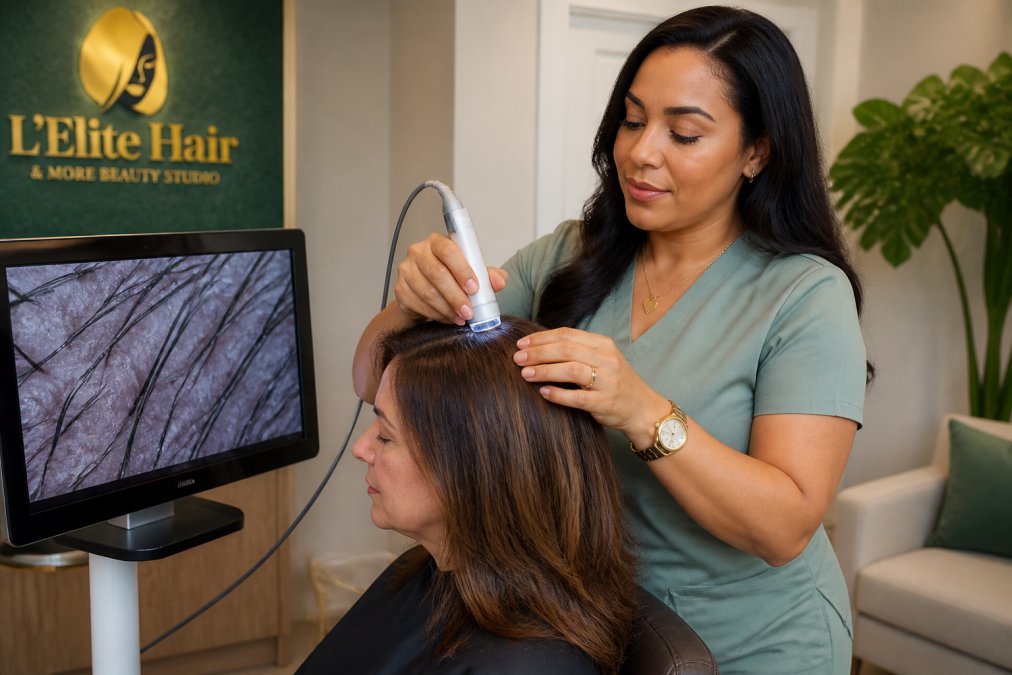
- Trichoscopy. A magnified view of the scalp shows whether follicles are empty, whether hair shaft diameters vary widely, and whether there is scaling or inflammation. This is where a microscopy scalp analysis in a professional setting can add real value, because it captures density and scalp condition as a baseline you can track over time.
- Lab work when indicated. A dermatologist or physician may order a complete blood count, ferritin, thyroid panel, and sometimes vitamin D or zinc. These rule out the deficiencies and thyroid issues that mimic telogen effluvium.
- Scalp biopsy. Reserved for unclear cases, such as when the pattern is patchy or when scarring alopecia is a concern.
Conditions That Can Look Like Telogen Effluvium
- Androgenetic alopecia, gradual, patterned thinning rather than sudden diffuse shedding
- Alopecia areata, smooth, round patches, sometimes with "exclamation point" hairs at the edge
- Scarring alopecias, scalp pain, redness, scaling, or permanent loss of follicles
- Anagen effluvium, rapid shedding during active medical treatment, with a much shorter timeline
- Trichotillomania, broken hairs of uneven length from repeated pulling
When to See a Dermatologist
Book an appointment if shedding lasts longer than six months, if you can see scalp through your hair, or if you have other symptoms like fatigue, unusual cold sensitivity, or menstrual changes. Those can point to thyroid dysfunction or iron deficiency, which need blood work and treatment. A dermatologist can order ferritin levels and thyroid panels and rule out conditions that mimic telogen effluvium.
The Microscopy Scalp Analysis Benefits of Seeing Your Scalp Up Close
Microscopy scalp analysis benefits clients by turning guesswork into a clear picture. A handheld scope magnifies the scalp and hair shafts, so you can see density, follicle activity, buildup, and inflammation that the naked eye misses.
How to Support Hair Growth After Shedding
Supporting regrowth means removing the trigger, feeding the follicle, and stopping anything that pulls or stresses fragile hair. It also means knowing what a realistic recovery looks like, so you can tell progress from a setback.
The Recovery Timeline, Step by Step
Telogen effluvium follows a predictable arc once the trigger is resolved: (Source: the National Institutes of Health)
- Weeks 0-4 after the trigger: shedding begins, often the most alarming phase
- Months 2-3: shedding typically peaks
- Months 3-6: shedding slows as follicles re-enter the growing phase
- Months 6-12: new growth becomes visible, short, fine hairs along the hairline and part
Nutrition and the Hair Cycle
Hair is built from protein, and the follicle depends on a steady supply of iron, zinc, folic acid, and amino acids. A nutritional deficiency in any of these can keep hair in the resting phase longer. Focus on adequate protein at every meal, iron-rich foods paired with vitamin C, and zinc from sources like legumes, nuts, and meat. Ask your doctor before starting supplements, since too much iron is harmful.
Gentle Hair Care Regimen Changes
- Wash with a mild, sulfate-free cleanser and let the scalp, not the ends, get the attention
- Skip tight braids, weaves, and high-tension styles until density recovers
- Detangle wet hair with a wide-tooth comb, starting at the ends
- Limit heat styling and chemical processing
- Keep appointments for trims so split ends do not travel up the hair shaft
Daily Habits That Support the Scalp Environment
- Massage the scalp for a few minutes daily to encourage circulation
- Keep the scalp clean without over-washing or stripping it
- Protect the scalp from sunburn with a hat or SPF
- Manage stress with sleep, movement, and whatever genuinely helps you decompress
- Stay hydrated and avoid crash diets
What to Skip During the Shedding Phase
- Aggressive scalp scrubbing, friction does not speed regrowth and can irritate the scalp
- Harsh chemical treatments and bleach until density stabilizes
- Tight protective styles that pull at the hairline
- Crash diets and extreme calorie restriction, which can re-trigger shedding
Where Professional Scalp Care Fits
Professional scalp care, including deep scalp detox and customized herbal scalp treatments, can support scalp balance while the hair cycle recovers. These services are supportive, not curative, and they work best alongside medical care when a medical cause is present. At L'Elite, a scalp wellness consultation paired with microscopy scalp analysis gives you a baseline to track against, and personalized hair and scalp wellness recommendations that fit your hair type and routine.
Scalp Wellness for Thinning Hair: Daily Habits That Help
Scalp wellness for thinning hair comes down to consistency. A healthy scalp environment supports healthy-looking hair, and that environment is built by small daily choices.
- Massage the scalp for a few minutes daily to encourage circulation
- Keep the scalp clean without over-washing or stripping it
- Protect the scalp from sunburn with a hat or SPF
- Manage stress with sleep, movement, and whatever genuinely helps you decompress
- Stay hydrated and avoid crash diets
Telogen Effluvium vs. Androgenetic Alopecia: Why the Difference Matters
The distinction matters because the two conditions behave differently and need different plans. Telogen effluvium is temporary and diffuse; androgenetic alopecia is a progressive pattern of thinning driven by genetics and hormones.
| Feature | Telogen Effluvium | Androgenetic Alopecia |
|---|---|---|
| Onset | Sudden, after a trigger | Gradual, over years |
| Pattern | Diffuse across the scalp | Crown and hairline, or widening part |
| Timeline | Often resolves in months | Progressive without treatment |
| Reversible | Usually yes | Managed, not reversed |
| Main approach | Remove trigger, support scalp | Medical treatment, e.g. minoxidil |
The Emotional Side of Shedding and Where to Find Support
Hair loss carries a real emotional weight that clinical guides often skip. Watching hair fall out by the handful is frightening, and it can affect confidence, mood, and how you show up in the world.
Frequently Asked Questions
How long does telogen effluvium usually last?
Most cases of acute telogen effluvium run their course within three to six months once the trigger has passed, though shedding may continue longer if the cause persists. Chronic telogen effluvium lasts more than six months and often needs a closer look from a dermatologist. Because the hair cycle moves slowly, you may notice shedding tapering off gradually rather than stopping overnight. Tracking your shedding month by month, and addressing the original trigger, gives you the clearest picture of your recovery timeline.
Is telogen effluvium permanent or temporary?
Telogen effluvium is generally temporary. It is a reactive process, meaning the hair follicles shift into the resting telogen phase in response to a stressor such as illness, surgery, or emotional stress, then return to normal growth once the trigger resolves. That said, if the underlying cause continues, shedding can persist. A professional scalp evaluation can help you understand whether your pattern looks like a short-term reaction or something that needs medical attention.
What vitamins help telogen effluvium?
No vitamin directly cures telogen effluvium, but correcting a nutritional deficiency can help your hair cycle return to normal. Iron deficiency with low ferritin levels, zinc, folic acid, and amino acids are the nutrients most often linked to shedding. A blood test from your doctor is the right first step before adding supplements, since taking extra nutrients you do not need will not speed recovery. Once levels are checked, your provider can recommend what, if anything, to add.
How can a professional scalp analysis help identify shedding patterns?
A microscopy scalp analysis lets a trained professional see your scalp and hair follicles up close, which can reveal diffuse thinning, scalp buildup, or changes in hair density that are hard to spot in a mirror. Seeing the pattern over time helps distinguish a reactive shedding episode from other types of hair loss. At L'Elite, Linda E., a certified trichologist, uses this type of consultation to build personalized hair and scalp wellness recommendations and to refer clients to a dermatologist when needed.