 blog
blog
Trichologist vs Dermatologist for Hair Loss in 2026
Table of Contents
- Trichologist vs Dermatologist: What Each One Actually Does
- Training, Credentials, and Scope of Practice Compared
- Hair Shedding vs Hair Loss: Which One Are You Experiencing?
- How Scalp Analysis for Hair Loss Works in Practice
- When to See a Dermatologist for Hair Loss
- Diagnosis vs Supportive Care: Building a Coordinated Plan
- Frequently Asked Questions
Last Updated: October 6, 2026
Trichologist vs Dermatologist: What Each One Actually Does
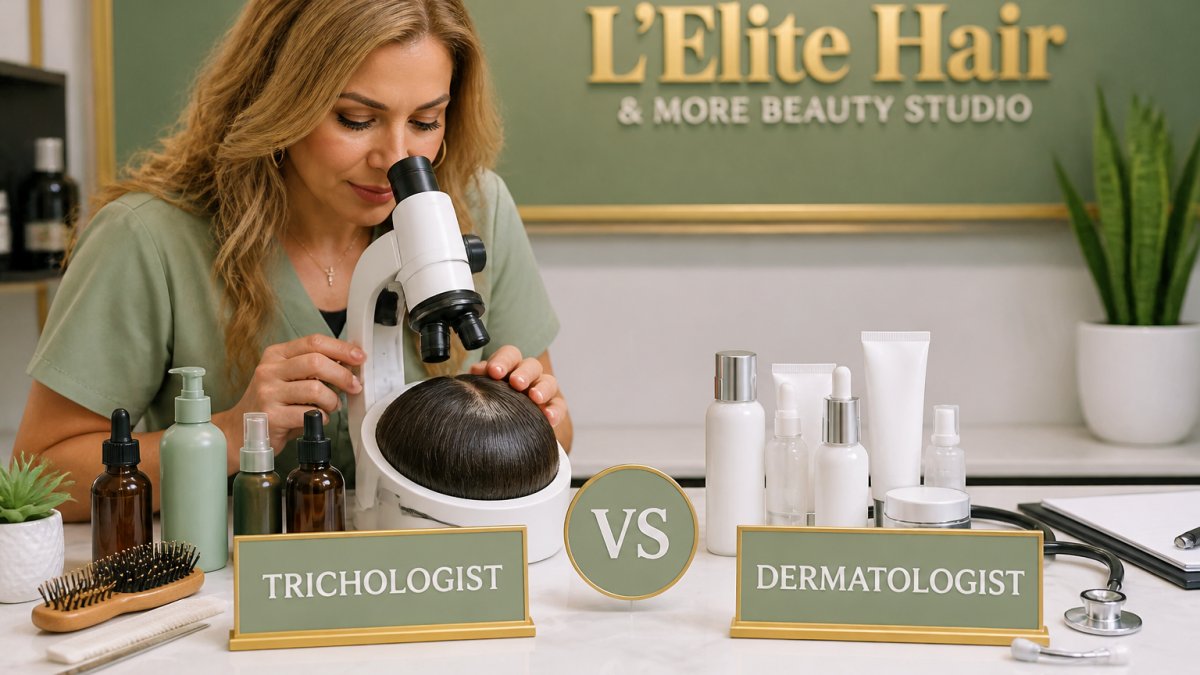
Choosing between a trichologist vs dermatologist for hair loss comes down to one question: does your scalp need medical diagnosis or professional scalp care? A trichologist is a trained hair and scalp specialist who evaluates shedding, thinning, and scalp condition, while a dermatologist is a medical doctor who diagnoses and treats skin and hair disorders.
Hair shedding and hair thinning are two of the most common concerns we hear about, and the confusion between the two professionals causes real delays. People book the wrong appointment, wait weeks, and leave without answers.
Here's what each one actually does, and how to decide which door to knock on first.
What Does a Trichologist Do?
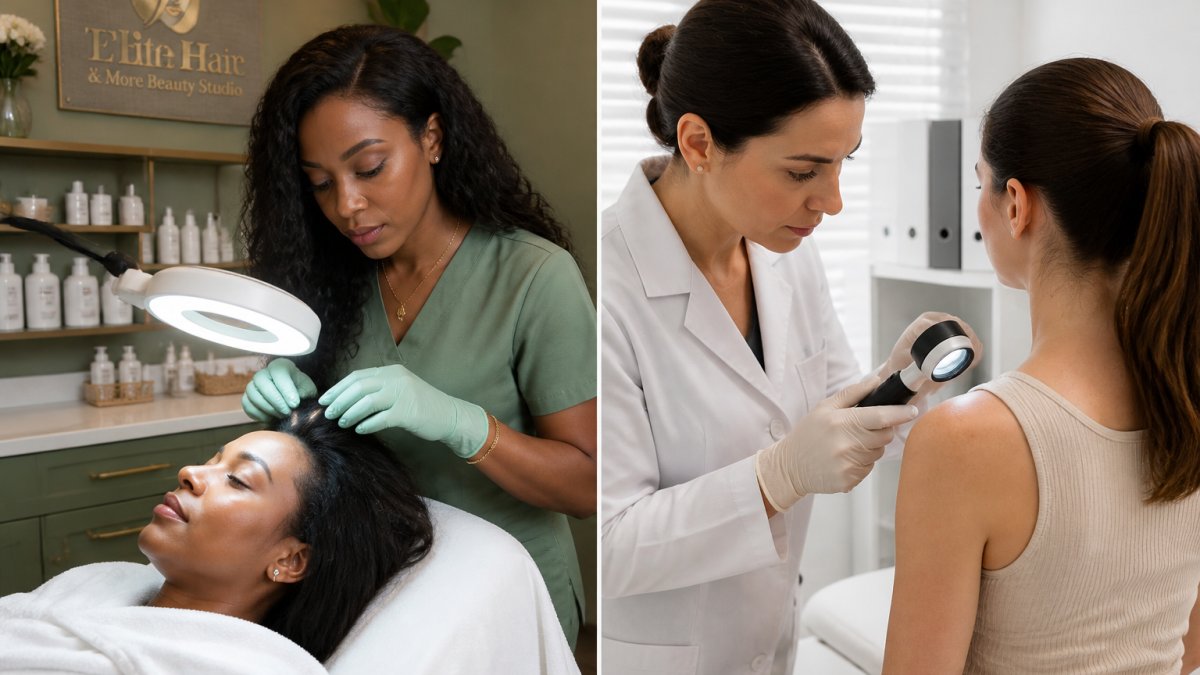
A trichologist studies the hair and scalp specifically. Their work centers on hair-growth cycles, follicle health, scalp symptoms, and the daily habits that affect both.
In practice, a trichologist will:
- Review your history, including styling habits, medications, and stress
- Perform a scalp examination and microscopy scalp analysis
- Identify buildup, inflammation, dryness, or breakage patterns
- Recommend scalp care, hair-care routines, and supportive treatments
What a trichologist cannot do is diagnose a medical condition or prescribe medication. That boundary matters, and any honest trichologist will tell you so.
What a Dermatologist Brings to Hair Loss
A dermatologist is a medical doctor who specializes in skin, hair, and nails. They can diagnose hair and scalp conditions, order diagnostic testing, and prescribe treatment.
That includes blood tests, scalp biopsy when needed, and prescription treatment for conditions like pattern hair loss or inflammatory scalp disease. If your shedding has an underlying cause inside the body, a dermatologist is the professional who can find it.
Training, Credentials, and Scope of Practice Compared
The two roles differ most in medical training and legal authority. A dermatologist completes medical school, a residency in dermatology, and board certification, which grants the legal right to diagnose conditions and prescribe medication. A trichologist completes specialized training in hair and scalp science, which grants the ability to assess, educate, and provide nonmedical scalp and hair care.
| Factor | Trichologist | Dermatologist |
|---|---|---|
| Training | Certified hair and scalp specialist | Medical doctor, board certified in dermatology |
| Can diagnose | No | Yes |
| Can prescribe | No | Yes |
| Orders blood tests or biopsy | No | Yes |
| Typical focus | Scalp care, shedding, hair-care advice | Hair disorders, skin diseases, treatment plans |
| Best for | Early thinning, scalp buildup, maintenance | Sudden loss, patchy loss, medical causes |
Why Trichology Credentials Vary So Much
Here is the part most comparison articles skip: trichology is not a licensed medical profession in most states. There is no single national licensing board that governs who may call themselves a trichologist, and no state medical board that oversees the title the way it oversees physicians, nurses, or even cosmetologists.
That means training standards range widely. Some practitioners complete structured, multi-month programs with coursework in hair biology, scalp conditions, and consultation skills. Others complete short online certificates. Both may use the word "certified," which is why the word alone tells you very little.
A few practical ways to check a trichologist's background before you book:
- Ask which certifying body issued the credential and how many hours of training it required.
- Ask whether the practitioner also holds a state-issued license, such as a cosmetology license, which is regulated and verifiable.
- Ask how they handle referrals, a well-trained trichologist will describe clear boundaries and name the situations where they send clients to a physician.
- Ask what happens during a consultation so you know whether you are getting a structured scalp assessment or a sales pitch.
A practitioner who welcomes these questions is usually a practitioner worth seeing. Evasiveness is its own answer.
What "Scope of Practice" Actually Means for You
Scope of practice is the legal line between what a professional may and may not do. For a trichologist, that line sits at diagnosis and prescription.
For a dermatologist, the scope is broad: medical history, physical examination, diagnostic testing, diagnosis, prescription treatment, and ongoing medical follow-up.
This is not a ranking of importance. It is a division of labor. A trichologist's value is time, attention, and scalp-focused education, often in a calmer, less rushed setting than a medical office. A dermatologist's value is medical authority. The strongest plan usually uses both.
Linda E. at L'Elite holds Certified Trichologist and Certified Hair Loss Practitioner credentials, alongside her cosmetology license and medical social work background. That combination shapes how consultations work here: education first, honest boundaries always, and a referral to a physician or dermatologist whenever a concern falls outside the scope of trichology or cosmetology services.
Hair Shedding vs Hair Loss: Which One Are You Experiencing?
Hair shedding and hair loss are not the same thing, and the distinction changes who you should see. Shedding is a normal part of the hair-growth cycle, where old strands release to make room for new ones. Hair loss means hair is not growing back at the same rate, or follicles are being affected by an underlying cause.
A quick self-check:
- Diffuse shedding: more strands than usual on the pillow, brush, or shower drain, spread evenly
- Pattern hair loss: gradual thinning at the part, crown, or temples
- Patchy hair loss: smooth, distinct bald spots
- Breakage: short broken strands, often from heat or chemical damage
Diffuse shedding often follows stress, illness, medication changes, or a life transition (Telogen Effluvium: A Review of the Literature). Pattern and patchy loss deserve medical evaluation. (Source: the National Institutes of Health (NIH))
How Scalp Analysis for Hair Loss Works in Practice
Scalp analysis for hair loss is a structured look at the scalp surface and hair density, not a guess. At L'Elite Hair & More Beauty Studio, a microscopy scalp analysis uses magnification to check the scalp for buildup, flaking, redness, and follicle density, then compares findings across zones of the head.
A typical session includes:
- A consultation covering history, styling habits, and concerns
- Magnified imaging of the scalp and hairline
- A density and shedding assessment
- A written summary of what we observed
- Personalized hair and scalp wellness recommendations
What most guides miss is that scalp analysis is a baseline, not a verdict. Repeating it months later is how you see whether a routine is actually helping.
When to See a Dermatologist for Hair Loss
See a dermatologist when hair loss is sudden, patchy, painful, or accompanied by other symptoms. Those patterns point toward a medical cause that needs diagnosis and possibly prescription treatment.
Book a medical appointment if you notice:
- Smooth bald patches appearing over days or weeks
- Loss alongside fatigue, weight change, or unusual periods
- Scalp pain, burning, or crusting
- Loss during or after chemotherapy or another medical treatment
- No improvement after several months of consistent scalp care
A Simple Decision Framework
Most guides stop at a symptom list. Here is how to actually use one. Ask yourself two questions: how fast did this happen, and is my scalp involved?
Fast and diffuse, call a physician or dermatologist first. Heavy shedding that starts suddenly and spreads evenly across the scalp often follows a stress event, illness, medication change, or major life transition.
Slow and diffuse, a scalp wellness consultation is a reasonable first step. Gradual thinning over months or years, without pain, scaling, or patches, is the pattern where professional scalp care and education shine.
Scalp symptoms present, medical evaluation first, regardless of speed. Redness, scaling, crusting, pain, or open areas on the scalp are not cosmetic concerns. Get those assessed before starting any scalp-care program.
Red Flags That Skip the Line
Some signs should move you straight to a medical appointment, not a wait-and-see approach:
- Loss that is accompanied by fever, joint pain, or unexplained weight change
- Scalp skin that looks shiny, smooth, and scarred in the areas of loss
- Burning, stinging, or tenderness in the scalp
- Loss that continues to accelerate despite consistent care
- Any loss that follows a new medication, with your prescribing provider notified
If any of these apply, contact a physician or dermatologist. A trichologist can support scalp health alongside that care, but should never replace it.
How to Prepare for Either Appointment
Whichever professional you see first, arrive with useful information. Bring a list of medications and supplements, note when you first noticed the change, and photograph your part and hairline in consistent lighting so you can show progression rather than describe it from memory. Mention recent illnesses, major stressors, dietary changes, and any family history of hair loss.
For general guidance on hair disorders, the American Academy of Dermatology hair loss resource is a reliable starting point. If you are unsure which door to knock on first, a scalp wellness consultation at L'Elite can help you organize what you are seeing and point you toward the right professional when medical evaluation is the better next step.
Diagnosis vs Supportive Care: Building a Coordinated Plan
The strongest plan uses both professionals for what each does best. Medical evaluation answers "why is this happening." Professional scalp care answers "what supports the scalp environment while we address it."
That division of labor looks like this:
- Dermatologist: diagnosis, diagnostic testing, prescription treatment, follow-up
- Trichologist or scalp specialist: scalp analysis, scalp care, hair-care advice, nonmedical support
- You: consistency, honest tracking, and follow-through on both plans
If you are navigating hair loss from chemotherapy, stress, or a major life transition, a coordinated approach matters more than any single appointment. L'Elite also offers medical wig and cranial prosthesis consultations for clients who want to restore appearance while treatment continues.
Hair loss rarely resolves on its own timeline, and guessing which professional to see first costs you months. If your concern is shedding, thinning, or scalp condition, start with a scalp wellness consultation and microscopy scalp analysis at L'Elite Hair & More Beauty Studio.
Frequently Asked Questions
Does insurance cover a trichologist?
Most health insurance plans do not cover trichology services because trichologists are not licensed medical providers. Visits are usually paid out of pocket. Dermatology visits, by contrast, are often covered when they are medically necessary, though a referral may be required depending on your plan. Before booking either type of appointment, call your insurance company and ask two questions: whether the provider is in network, and what your plan covers for hair and scalp conditions. That single phone call prevents most billing surprises.
Can a trichologist diagnose the cause of hair loss?
A trichologist can assess your scalp, examine hair density and shedding patterns, and identify visible signs like buildup, inflammation, or breakage. What a trichologist cannot do is issue a medical diagnosis or order blood work and biopsies. If your scalp analysis points to a possible underlying cause such as a thyroid issue, nutritional deficiency, or skin disease, the right next step is a referral to a dermatologist or physician. Think of trichology as the assessment and supportive care layer, not the diagnostic one.
Should I see a trichologist or dermatologist first for hair loss?
It depends on what you are seeing. Gradual thinning, persistent flaking, or a scalp that feels tight and irritated are reasonable starting points for a trichologist, who can perform a scalp analysis and recommend supportive care. Sudden shedding, patchy bald spots, scalp pain, or hair loss alongside fatigue and weight changes call for a dermatologist first, since those signs may need blood tests or a scalp biopsy. When in doubt, start with your primary care physician and let them guide the referral.
What do most dermatologists recommend for hair loss?
Dermatologists typically begin with a patient history and scalp examination, then order blood tests or a biopsy if the cause is unclear. Treatment plans often include prescription topical treatments, oral medications, or in-office procedures, depending on the type of hair loss. Many also recommend gentle hair-care habits and stress management as supporting measures. A dermatologist can also refer you to a trichologist for ongoing scalp wellness care between medical visits, which is where coordinated care becomes valuable.