 ultimate-guide
Healthy Styling Services for Hair Integrity
Table of Contents
- What Hair Integrity Really Means for Holistic Wellness
- Scalp-First Care: Why Healthy Styling Services Start at the Root
- Hair Breakage Prevention During Everyday Styling
- Protective Hairstyles for Healthy Hair and Less Tension
- What Happens in a Scalp Wellness Consultation
- Microscopy Scalp Analysis: Seeing Your Scalp Up Close
- Aftercare Plans and Measurable Signs of Hair Integrity
- Conclusion: Building a Long-Term Healthy Styling Routine
- Frequently Asked Questions
Last Updated: October 7, 2026
What Hair Integrity Really Means for Holistic Wellness
Hair integrity is the structural strength, moisture balance, and cuticle condition that let hair grow, bend, and recover without snapping.
Hair often signals internal stress first: sudden shedding, breakage, and dryness can reflect nutrition or hormonal shifts. A holistic approach looks at the whole picture, scalp condition, styling habits, products, and lifestyle. This guide covers scalp-first care, breakage prevention, protective styling, and the consultations that tie it together.
Scalp-First Care: Why Healthy Styling Services Start at the Root
The scalp is skin, and hair grows out of it, which reshapes how healthy styling services should work. A tight, flaky, or congested scalp makes it harder for follicles to do their job, and no styling skill compensates for a struggling scalp.
This is where scalp-first care separates a wellness studio from a traditional salon chair. The American Academy of Dermatology guidance on scalp health notes that gentle, consistent scalp care supports the conditions hair needs to thrive.
How We Actually Assess Scalp and Hair Before Recommending a Service
A scalp-first appointment starts with assessment, not a service menu. Before recommending anything, we walk through a structured evaluation:
- History and context. Styling routine, recent chemical services, medications, hormonal shifts, stress, diet, and what you have already tried.
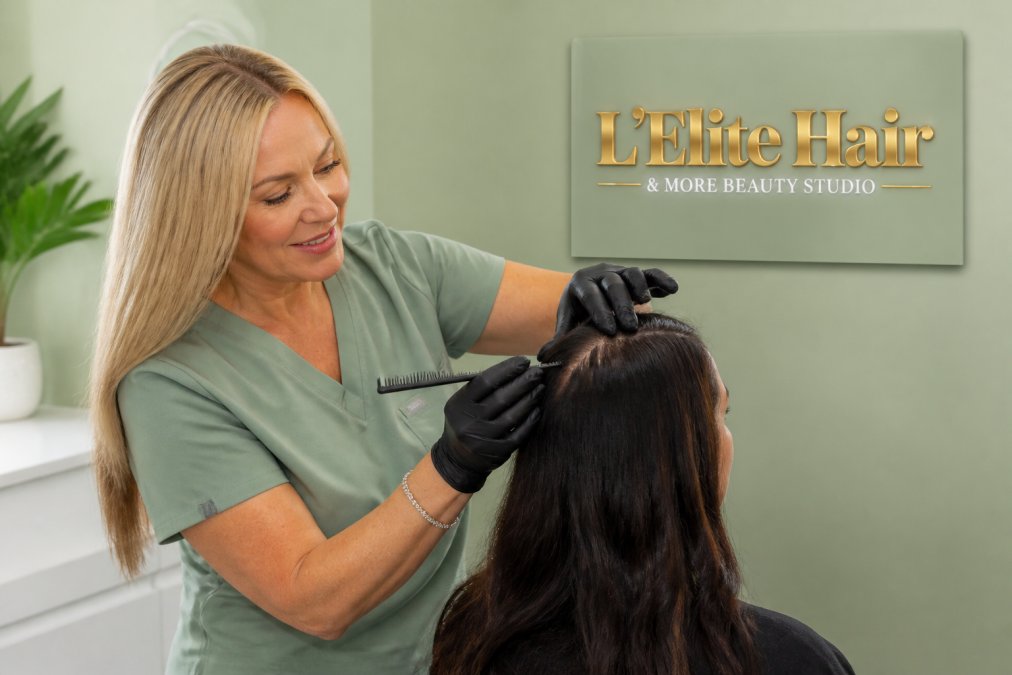
- Visual scalp exam. Buildup, flaking, redness, oil distribution, tenderness, and follicle-opening condition, viewed under magnification.
- Strand testing. Porosity, elasticity, and density along the part and hairline.
Those inputs determine whether the next step is a deep scalp detox, a customized herbal scalp treatment, LED hair therapy, a Japanese Head Spa session, or a revised wash-and-condition routine. The service follows the assessment, never the reverse.
What "Natural," "Organic," and "Holistic" Actually Mean on a Label
These words are marketing terms, not regulated standards. "Natural" can describe one botanical ingredient in an otherwise synthetic formula, "organic" on a personal-care product isn't governed like organic food certification, and "holistic" describes an approach, treating scalp, hair, and lifestyle together, not an ingredient list.
That doesn't make the words useless, it means reading the formula, not the front of the bottle. A few habits:
- Look for humectants such as glycerin, aloe, and honey, which draw and hold water in the strand.
- Pair oils with water-based products. Oils seal moisture in; they do not add it.
- Use lightweight proteins (hydrolyzed rice, silk, or wheat) on damaged strands, but not every wash, protein overload makes hair stiff and brittle.
If a product promises to cure thinning or regrow hair, that claim is outside what a cosmetic product can deliver. Bring the bottle to your consultation and we'll read it with you.
Why Scalp Care Feels Slow at First
If your routine is built entirely around styling products, expect an adjustment period. Scalp care is slower and less visible at first, but it changes everything downstream. Most clients notice a calmer scalp within a few weeks and clearer change in strand behavior over a longer stretch.
If you are not sure where your scalp stands, a scalp wellness consultation or a microscopy scalp analysis is the most efficient first step. Both are available at L'Elite Hair & More Beauty Studio in Bonita Springs and serve clients throughout Naples, Estero, Fort Myers, and Southwest Florida.
Hair Breakage Prevention During Everyday Styling
Most breakage isn't dramatic, it accumulates in small, repeated stresses: the same ponytail position, hot tool setting, or rough towel dry. Hair breakage prevention starts with noticing those patterns and interrupting them.
Heat Styling Limits and Tool Habits That Protect Strands
Heat is the fastest way to weaken a strand, and the damage is cumulative. A common mistake is treating one "safe" temperature as universal. Fine, lightened, or relaxed hair tolerates far less heat than coarse, virgin texture. We recommend lower settings with more passes over high heat with fewer, and always with a heat protectant. Keep the iron or dryer moving.
Moisture, Hydration, and Product Choices That Support Strength
Dry hair snaps; hydrated hair stretches and returns. Moisture is water content, while hydration describes how well the strand holds and balances it. Oils seal but don't hydrate on their own, so pair them with water-based leave-ins.
Read labels skeptically. "Naturally inspired" is a marketing phrase, not a standard, and says nothing about whether a formula suits your hair type.
Protective Hairstyles for Healthy Hair and Less Tension
Protective hairstyles for healthy hair work by reducing daily manipulation, but only when installed with the right tension. A style that pulls at the hairline causes more harm than leaving hair loose.
Braids, twists, and low buns all qualify when done gently and rotated so stress doesn't land on the same section of scalp.
For clients with thinning or shedding concerns, we adjust protective styling to avoid tension on vulnerable areas.
Aftercare by Service Type: What to Do Between Appointments
Protective styling is only half the equation. Here is how we coach clients through the most common service types: (Source: National Institutes of Health (NIH) on hair follicle biology)
Silk Press. A silk press uses heat to smooth the cuticle without the chemical bond-breaking of a relaxer.
Color and lightening services. Freshly colored hair is more porous and fragile, especially after lightening.
Curls and coils. Curl integrity depends on moisture balance and gentle handling. Detangle wet with conditioner and a wide-tooth comb or fingers, never dry.
Texture, Sensitivity, and Budget: One Size Does Not Fit All
Holistic care only works if it fits your actual hair, scalp, and life. We adjust for:
- Texture and density. Fine, low-density hair tolerates less tension and heat than coarse, high-density hair. The same braid pattern can be protective on one head and damaging on another.
- Sensitivities and allergies. If you have reacted to a color, relaxer, or adhesive before, tell us. Patch testing is a standard precaution for chemical services and some adhesives.
- Scalp conditions. Psoriasis, seborrheic dermatitis, and active irritation change what we can safely do in the chair. Sometimes the right answer is a referral before a service.
Risks, Limitations, and When to See a Dermatologist
No styling service is risk-free, and honest guidance means naming the limits:
- Chemical services carry real risk. Relaxers, lighteners, and some dyes can cause burns, breakage, or allergic reactions. Patch and strand testing reduce but do not eliminate that risk.
- Traction is cumulative. Repeated tight styling can thin the hairline and temples over time. Rotating styles and giving edges rest is the main defense.
- Heat damage is permanent. Once the cuticle is compromised by excessive heat, it does not fully recover. Prevention is the only real strategy.
At L'Elite, we do not diagnose medical conditions and we do not promise to cure hair loss. What we can do is support scalp wellness, help maintain a healthy scalp environment, and refer you to the right professional when a concern falls outside the scope of cosmetology or trichology.
If you're planning a silk press, a color service, or a protective style and want it built around your scalp and hair integrity, book a scalp wellness consultation with L'Elite Hair & More Beauty Studio. Linda E., a licensed cosmetologist and certified trichologist, will assess your scalp, review your history, and build a personalized plan, including aftercare, that supports healthy-looking hair between visits.
What Happens in a Scalp Wellness Consultation
A scalp wellness consultation is a structured, unhurried conversation and assessment, not a sales pitch. We start by listening: your history, styling routine, medications, recent stress, and what you've already tried.
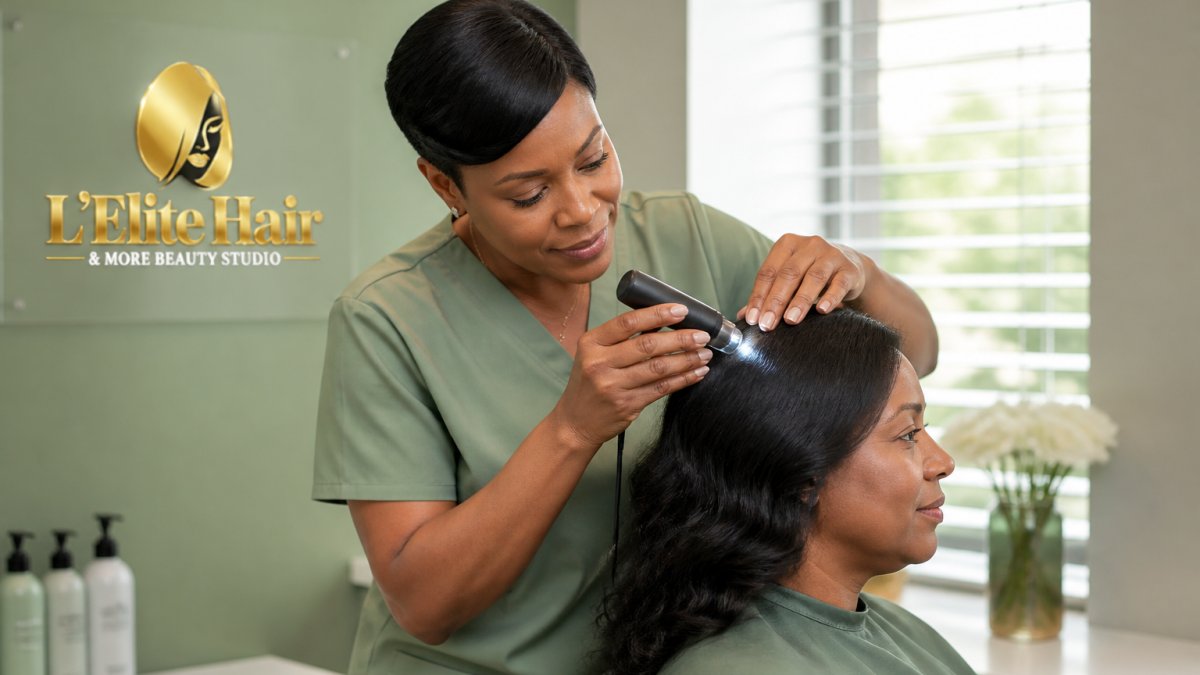
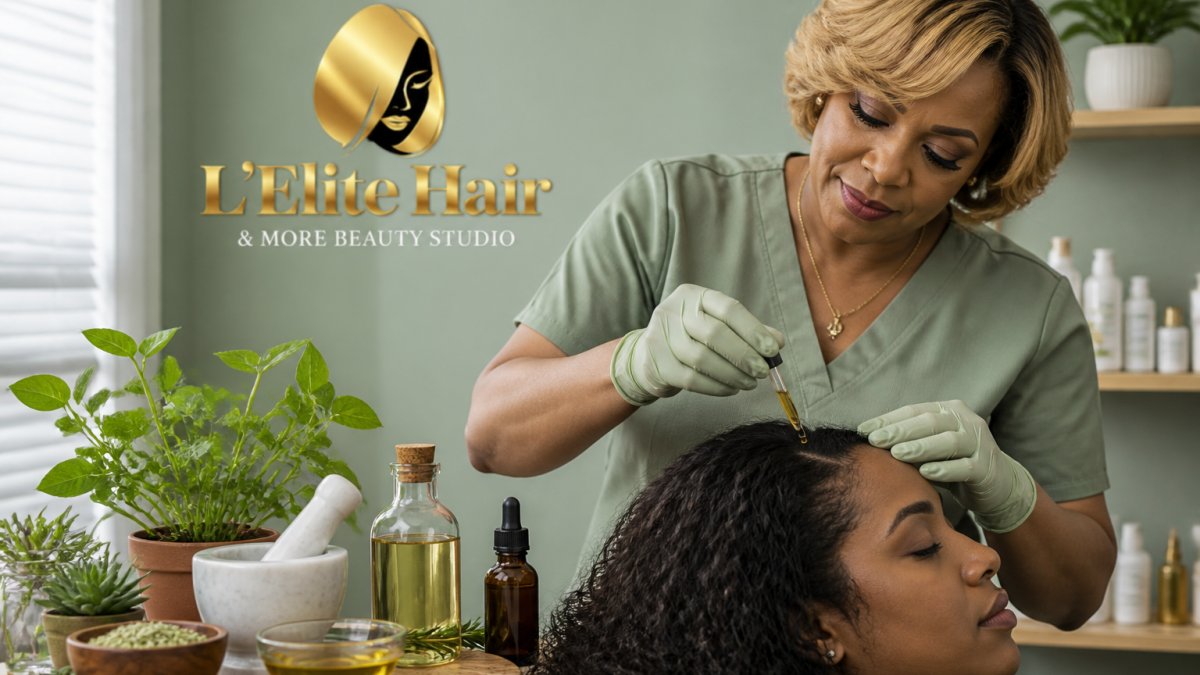
From there we build personalized hair and scalp wellness recommendations, which might include a deep scalp detox, LED hair therapy, herbal treatments, or simply a revised home routine.
Microscopy Scalp Analysis: Seeing Your Scalp Up Close
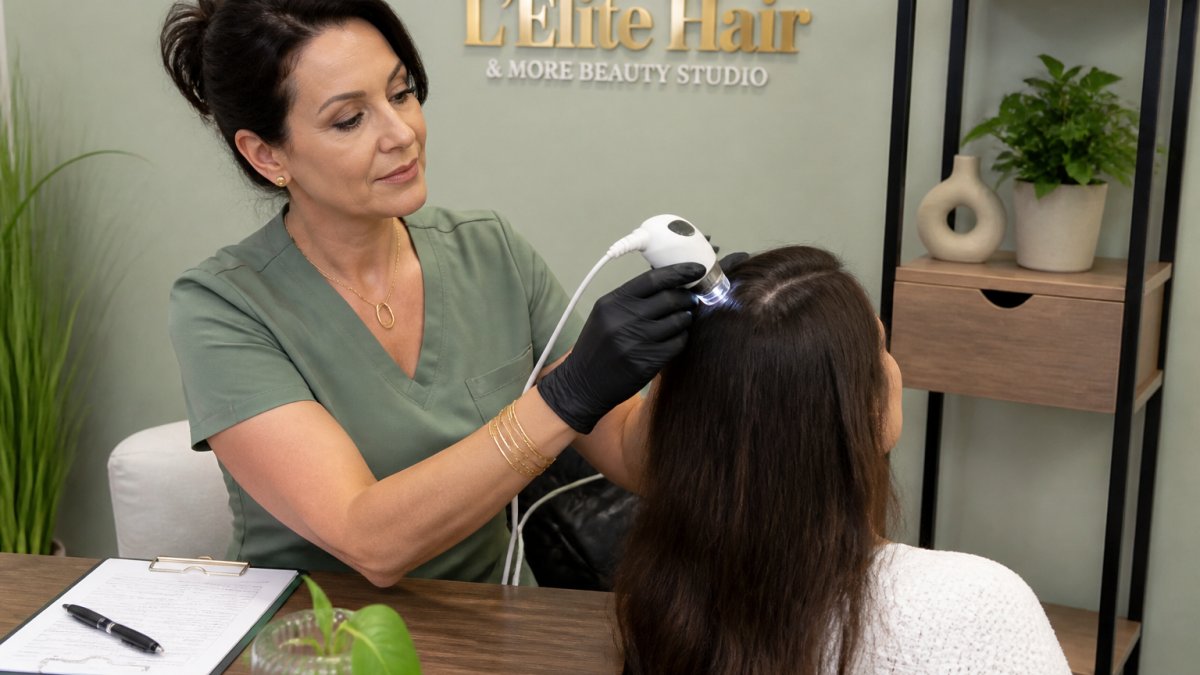
Microscopy scalp analysis turns guesswork into evidence. Using a specialized scope, we magnify the scalp and follicles to see what the naked eye misses: buildup around the follicle opening, flaking, redness, oil distribution, and the condition of individual strands.
Seeing your own scalp on screen is often the moment clients finally understand what's been happening. It also gives us a baseline: comparing images over time shows whether a treatment plan is supporting improvement, which is far more useful than relying on memory.
Aftercare Plans and Measurable Signs of Hair Integrity
An aftercare plan keeps progress going between appointments. We map out a realistic home routine: wash frequency, which products to use and which to retire, heat limits, and how to handle protective styling, a plan that fits your actual life, not an ideal version of it.
You can track hair integrity at home with a few simple checks:
| Sign to Track | What Healthy Looks Like | What to Watch For |
|---|---|---|
| Elasticity | Wet strand stretches and returns | Snaps quickly or stays stretched |
| Shedding volume | Consistent, modest daily amount | Sudden or increasing shedding |
| Breakage | Few short broken pieces | Lots of short strands on pillow or brush |
| Scalp feel | Calm, no persistent itch or soreness | Itching, tenderness, or flaking |
| Shine and movement | Natural luster, flexible strands | Dull, stiff, or brittle feel |
Sudden or unexplained changes in shedding, scalp pain, or patchy loss deserve a medical evaluation. Those aren't styling problems, and no salon service should be presented as a substitute for one.
Conclusion: Building a Long-Term Healthy Styling Routine
Healthy hair isn't a single treatment; it's a routine that respects the scalp first.
At L'Elite Hair & More Beauty Studio, Linda E., a licensed cosmetologist and certified trichologist, builds personalized plans around microscopy scalp analysis, scalp wellness consultations, customized herbal treatments, and LED hair therapy, all designed to support healthy-looking hair without promising what no salon can.
Book a scalp wellness consultation with L'Elite and get a clear, personalized plan for stronger, healthier-looking hair.
Frequently Asked Questions
How can healthy styling services help maintain hair integrity?
Healthy styling services focus on technique, tool temperature, tension, and product choice so hair keeps its strength, moisture, and cuticle smoothness. A stylist trained in scalp-first care assesses your hair type and condition before styling, avoids excessive heat and tight pulling, and recommends a maintenance schedule. At L'Elite Hair & More Beauty Studio, services such as Silk Press, natural hair styling, and precision haircuts are paired with scalp wellness guidance so styling supports hair condition instead of wearing it down.
What styling practices can help reduce hair breakage?
Keep heat tools on lower settings and always use a heat protectant. Detangle from the ends upward with a wide-tooth comb or your fingers. Avoid brushing wet hair aggressively, since strands stretch and snap more easily when saturated. Space out chemical treatments and color services, and give hair rest days between tight styles. Trimming split ends every few months stops small splits from traveling up the strand. These habits, combined with regular scalp care, support hair strength and reduce breakage over time.
Can a scalp wellness consultation help with thinning or shedding?
A scalp wellness consultation reviews your history, styling habits, products, and scalp condition, then builds a personalized plan. It can identify buildup, dryness, or tension habits that affect how hair looks and feels, and it can recommend services such as deep scalp detox or LED hair therapy that support a healthy scalp environment. It does not diagnose medical conditions. If shedding is sudden, patchy, or unexplained, the consultation includes a referral to a dermatologist or licensed healthcare professional.
Is it worth seeing a trichologist for hair and scalp concerns?
A certified trichologist looks at the scalp and hair from a wellness and cosmetic standpoint, which can be useful when you want practical guidance on care routines, product choices, and styling habits. A trichologist does not replace a dermatologist for medical diagnosis. Many clients find value in combining both: a trichologist for ongoing scalp wellness support and a dermatologist for medical evaluation. L'Elite offers consultations through L'Elite Hair Loss Experts for clients concerned about thinning, shedding, or breakage.
When should I see a dermatologist about hair loss or scalp symptoms?
See a dermatologist if you notice sudden or rapid shedding, bald patches, redness, scaling, pain, or open sores on the scalp. These signs can point to conditions that need medical evaluation. A dermatologist can also help if hair loss follows an illness, medication change, or hormonal shift. Scalp wellness services support the scalp environment and styling habits, but they do not diagnose or treat medical conditions. When a concern falls outside cosmetic care, L'Elite refers clients to an appropriate licensed professional.
How can I choose a hairstyle that is gentle on my hair?
Pick styles that avoid pulling at the roots and allow your scalp to breathe. Loose braids, low buns, and twists without tight edges are gentler than high-tension styles. Rotate your look so the same spots are not stressed every week, and take styles down carefully instead of ripping through them. Silk or satin pillowcases reduce friction overnight. If a style causes soreness or bumps along the hairline, it is too tight and should be adjusted or removed.