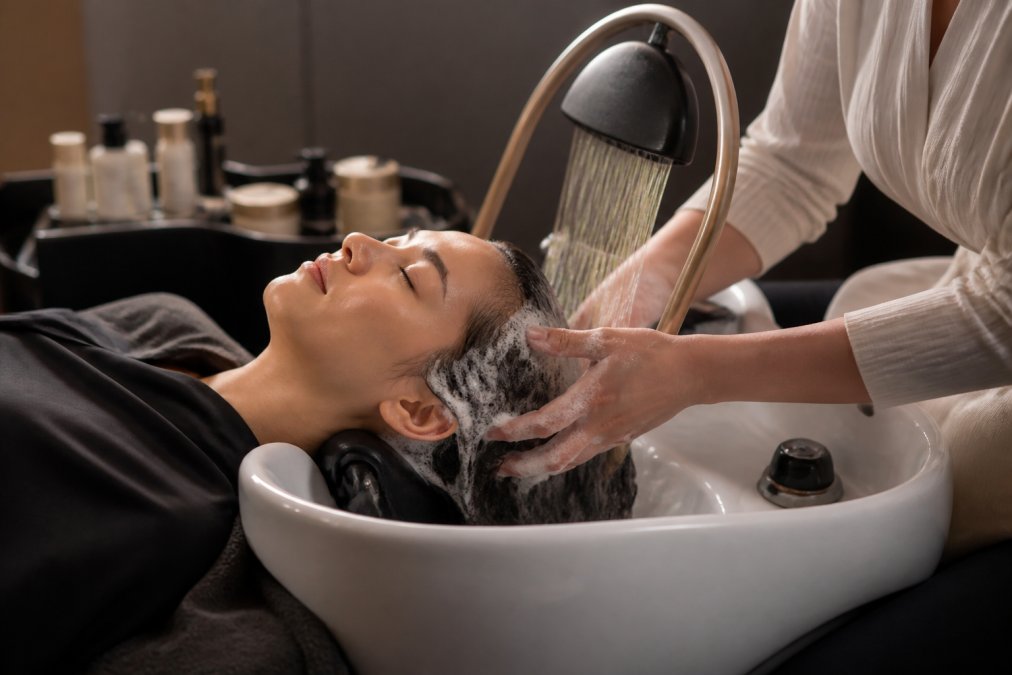
 ultimate-guide
Japanese Head Spa: Benefits, Cost & What to Expect
Table of Contents
- What Is a Japanese Head Spa?
- The Benefits of Scalp Massage and Japanese Head Spa Therapy
- Step-by-Step: What Happens During a Japanese Head Spa Session
- How Long Is a Head Spa Session?
- Japanese Head Spa Cost: What Affects the Price
- Who Should Get a Head Spa? (And Who Should Avoid It)
- DIY vs. Professional: What You Can (and Can't) Replicate at Home
- Frequently Asked Questions
Last Updated: September 12, 2026
What Is a Japanese Head Spa?
A Japanese head spa is a professional scalp treatment that combines deep cleansing, steaming, massage, and scalp analysis to restore the health of the scalp and hair. At L'Elite Hair & More Beauty Studio, we explain it as a facial for your scalp, and that comparison holds up once you understand what happens during a session.
The treatment originated in Japan, where scalp health has long been treated as the foundation of healthy hair. Rather than focusing only on the strands, a head spa targets the scalp itself: the skin, hair follicles, sebum balance, and micro-circulation that determine how your hair grows and looks. A japanese head spa is not a shampoo upgrade. It is a structured, multi-step service built around scalp condition.
How It Differs from a Standard Salon Wash
A standard salon wash cleans the hair. A head spa treats the scalp.
In a typical wash, shampoo goes on, lathers briefly, and gets rinsed. In a head spa, the practitioner begins with a scalp analysis, often using a microscope camera, then works through cleansing, exfoliation, steaming, and extended massage that targets pressure points and lymphatic drainage. The session addresses sebum buildup, dead skin, and scalp tension that a quick wash never touches.
Most people notice the difference in how their scalp feels first: lighter, calmer, less tight. Hair texture and shine tend to follow.
The Benefits of Scalp Massage and Japanese Head Spa Therapy
The benefits of scalp massage and head spa therapy come down to improved scalp condition. When the scalp is clean, balanced, and receiving healthy blood flow, hair follicles have a better environment to work with. That is the core mechanism behind most reported benefits, and it is worth understanding the mechanism itself, because it separates a head spa from a pleasant shampoo.
The Micro-Circulation Mechanism
Hair follicles sit in the dermis, fed by a network of small blood vessels called the dermal papilla. When those vessels are constricted, by tension, inflammation, or sebum and dead-skin buildup at the follicle opening, nutrient and oxygen delivery to the follicle drops. Scalp massage applies mechanical pressure that dilates peripheral vessels and increases localized blood flow, which is the same principle behind manual lymphatic drainage used in other body treatments. Steaming adds a second lever: warm micro-mist softens sebum plugs and the keratinized layer at the scalp surface, making exfoliation more effective without abrasion. The result is a scalp that is both cleaner at the surface and better perfused underneath.
This is why practitioners describe the treatment as addressing the environment for hair rather than the hair itself. A strand that has already grown is dead protein; nothing applied to it changes its structure. The follicle is living tissue, and that is the only part of the system a treatment can actually influence.
Stress Relief and Mental Wellness
The scalp, neck, and shoulders hold tension that accumulates from stress, screen posture, and jaw clenching. Slow, rhythmic pressure on these areas triggers a parasympathetic response, lowered heart rate, slower breathing, reduced muscle guarding (PubMed). Because scalp tension can restrict the same blood flow the massage is trying to improve, easing it supports both comfort and circulation at once. This is why the treatment is often described as relaxation therapy as much as hair care, and why clients frequently report better sleep the night of a session.
Hair Rejuvenation and Growth Support
A healthy scalp is the prerequisite for healthy hair. Deep cleansing removes sebum buildup and product residue that can clog follicle openings. Improved micro-circulation delivers nutrients to the follicle. Steaming helps open the hair cuticle and supports moisture balance. None of this guarantees new growth, and practitioners should never promise it, claims of regrowth cross into medical territory and belong with a dermatologist, not a spa. What a head spa can do is create the conditions where the follicle's normal cycle is less likely to be disrupted.
What the Evidence Actually Supports
It helps to separate what is well established from what is plausible but unproven:
- Well supported: temporary reduction in scalp oiliness and flaking after cleansing and exfoliation; short-term relaxation and stress reduction; improved scalp feel and appearance.
- Plausible, not proven: long-term effects on hair density or growth rate from massage alone. Some small studies suggest massage may support follicle activity, but the evidence is not strong enough to promise results (PubMed).
- Not supported: treating diagnosed hair loss conditions such as androgenetic alopecia or alopecia areata. Those require medical evaluation.
Step-by-Step: What Happens During a Japanese Head Spa Session
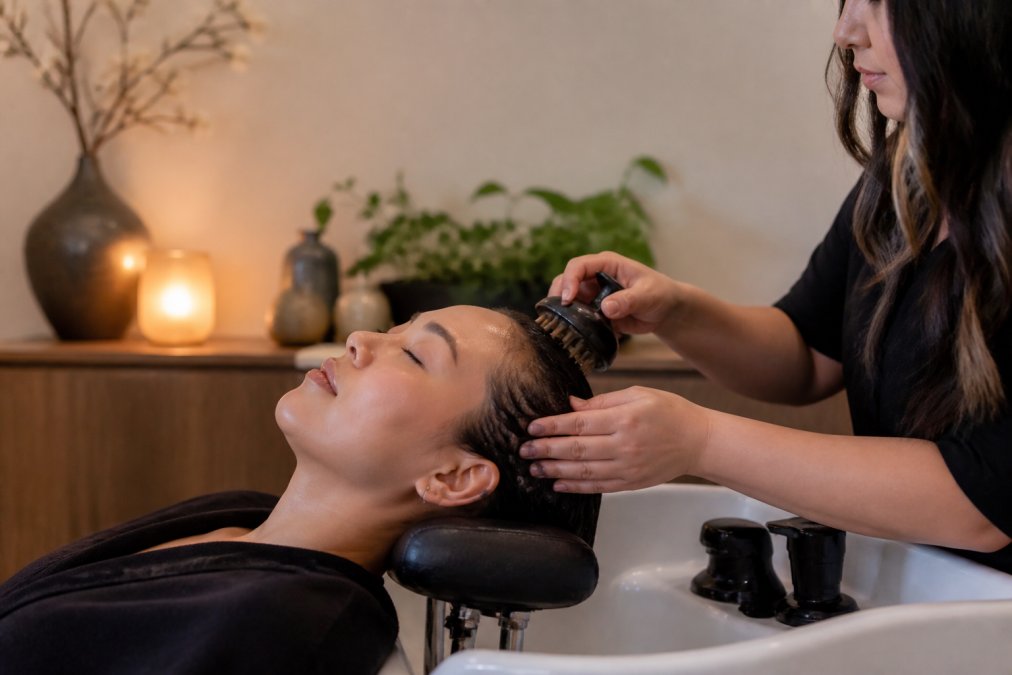
A typical session follows a consistent sequence, though the details vary by provider and by your scalp condition. Here is how the process generally unfolds.
Scalp Analysis and Consultation
The session starts with a conversation and a look at your scalp, often under magnification. A microscopy scalp analysis reveals oil levels, flaking, redness, follicle density, and buildup that you cannot see in a mirror. This step determines which products and techniques the practitioner uses, and it is where a good provider separates itself from a rushed one.
Cleansing, Steaming, and Massage
The treatment itself moves through several stages:
- Deep cleansing with a scalp-specific cleanser to lift oil and residue
- Exfoliation to remove dead skin and product buildup
- Steaming treatment to soften the scalp and open the hair cuticle
- Extended scalp massage targeting pressure points, the neck, and shoulders
- Lymphatic drainage techniques to reduce fluid retention and puffiness
- Nourishing process with a treatment mask or serum matched to your scalp
- Rinse and finish, sometimes with a cool-water seal for shine
A common mistake is treating this as purely indulgent. The cleansing and exfoliation steps are the ones that change scalp condition; the massage is what makes you want to come back.
How Long Is a Head Spa Session?
A head spa session typically runs 45 to 90 minutes, depending on the provider and the depth of treatment (peer-reviewed research). Shorter sessions focus on cleansing and massage. Longer sessions add scalp analysis, extended steaming, and treatment masks. If you are booking your first appointment, plan for the longer end, since the consultation and analysis add time.
Japanese Head Spa Cost: What Affects the Price
Pricing for a Japanese head spa varies widely, but the structure behind it is fairly consistent. Understanding what drives the number helps you compare providers on value rather than sticker price alone.
What Drives the Price
- Session length. A 45-minute express treatment and a 90-minute full-service session are different products. Most of the price difference tracks time directly.
- Scalp analysis. A microscopy scalp analysis requires a scope, a trained eye, and time to interpret what it shows. Some providers bundle it; others charge separately.
- Products and treatment masks. Scalp-specific cleansers, exfoliants, and serums vary widely in cost, and premium lines raise the total.
- Practitioner credentials. Licensed cosmetology, trichology training, and years of scalp-specific experience all factor in. A provider who can read a scalp scope and adjust treatment mid-session is charging for judgment, not just time.
- Add-ons. LED therapy, herbal steam blends, extended lymphatic drainage, and hot-stone work are typically priced as upgrades.
- Setting. A dedicated scalp studio with specialized equipment carries different overhead than a chair in a general salon.
How to Compare Quotes
When you call around, ask these questions so you are comparing like with like:
- How long is the actual treatment, excluding consultation and rinse?
- Is the scalp analysis included, and do I get to see the images?
- What products are used, and can I see the ingredient list if I have sensitivities?
- Is there a package rate for multiple sessions, and does it expire?
- What is the cancellation policy?
A lower price that skips the analysis or rushes the massage is not a better deal, it is a different service. The analysis is the single most useful part of the appointment for tracking changes over time, so a quote that excludes it should be evaluated with that in mind.
Budgeting for Results
Because results are cumulative, the realistic cost is the cost of a series, not a single visit. Most practitioners recommend starting with a short series spaced a few weeks apart, then moving to maintenance. Ask for the package price up front so you can plan for the full course rather than being surprised after session one.
Because pricing is set individually by each studio, the most reliable approach is to ask directly. L'Elite Hair & More Beauty Studio provides current pricing and package options on request, and a consultation is the best way to understand what a treatment plan would cost for your specific scalp needs.
Who Should Get a Head Spa? (And Who Should Avoid It)
Most adults can benefit from a head spa, particularly anyone dealing with an oily or flaky scalp, product buildup, thinning hair, or ongoing stress. It is also a supportive service for people navigating hair loss from medical treatment, life transitions, or chronic stress, provided it is adapted to their scalp condition.
Contraindications and Safety
A head spa is not appropriate for everyone at every time. Skip or postpone treatment if you have:
- An active scalp infection, open wounds, or a recent chemical burn
- A severe inflammatory scalp condition that is currently flaring
- Recent chemical processing that has left the scalp raw
- Known allergies to specific oils, fragrances, or treatment ingredients
If you are undergoing chemotherapy or another medical treatment, or if you have a diagnosed scalp or skin condition, check with your physician before booking. A qualified practitioner will also screen you during consultation and adjust or decline treatment when it is not safe.
DIY vs. Professional: What You Can (and Can't) Replicate at Home
You can support scalp health at home, but you cannot fully replicate a professional head spa.
What works at home:
- Gentle daily scalp massage with fingertips for a few minutes
- A clarifying scalp exfoliant used weekly, not daily
- Avoiding heavy product buildup and washing after workouts
- Reducing heat styling that stresses the scalp
What requires a professional:
- Microscopy scalp analysis and interpretation
- Proper steam and temperature control
- Lymphatic drainage technique
- Treatment selection matched to your actual scalp condition
The equipment and technology matter here. A microscope reveals what your scalp is doing; a trained eye knows what to do about it. That combination is what you are paying for.
Scalp concerns rarely resolve with a single product, and they rarely resolve alone. A japanese head spa gives you a clear picture of what your scalp actually needs, then treats it with the right technique and follow-through. At L'Elite Hair & More Beauty Studio, our team combines licensed cosmetology, trichology, and scalp wellness expertise to build a plan around your scalp, not a generic package. Book a scalp wellness consultation to start with a microscopy scalp analysis, a personalized treatment plan, and ongoing support for hair thinning, shedding, or stress-related changes. Get started with L'Elite Hair & More Beauty Studio and give your scalp the care it has been missing.
Frequently Asked Questions
What happens in a Japanese head spa?
A Japanese head spa typically begins with a scalp analysis and consultation. Then the provider performs a deep cleansing, often with steam, followed by a scalp massage that targets pressure points, and sometimes a nourishing treatment. The session ends with a rinse and styling. The focus is on scalp health, relaxation, and improving hair condition.
Is a Japanese head spa worth it?
Many people find it worthwhile for relaxation, scalp detox, and improved hair texture. It can help with issues like sebum buildup, scalp tension, and dull hair. However, results vary, and it's not a medical treatment. If you have specific scalp conditions, consult a dermatologist first. For general wellness and pampering, it offers a unique sensory experience.
Why is Japanese head spa so expensive?
The cost reflects the specialized training, time, and tools involved. Sessions often last 60 to 90 minutes and include a detailed scalp analysis, multiple cleansing and massage steps, and sometimes steam or LED therapy. The provider's expertise in scalp health and the use of high-quality products also contribute to the price. Pricing varies by location and service menu.
How often should you get a Japanese head spa treatment?
Frequency depends on your scalp condition and goals. Some people go monthly for maintenance, while others visit every two to three weeks if dealing with buildup or tension. For general relaxation, once a month is common. Your provider can recommend a schedule based on your scalp analysis and lifestyle.