
 ultimate-guide
LED Hair Therapy for Alopecia: Real Benefits Explained
Table of Contents
- LED Hair Therapy for Alopecia: What the Research Shows
- LED Light Therapy Frequency for Hair: Finding Your Treatment Rhythm
- The Microscopy Scalp Analysis Benefits Before You Commit
- How to Improve Scalp Health Naturally Alongside LED Sessions
- Combining LED Hair Therapy With Professional Scalp Care
- What to Expect: Timeline, Maintenance, and Realistic Goals
- Frequently Asked Questions
Last Updated: September 20, 2026
LED Hair Therapy for Alopecia: What the Research Shows
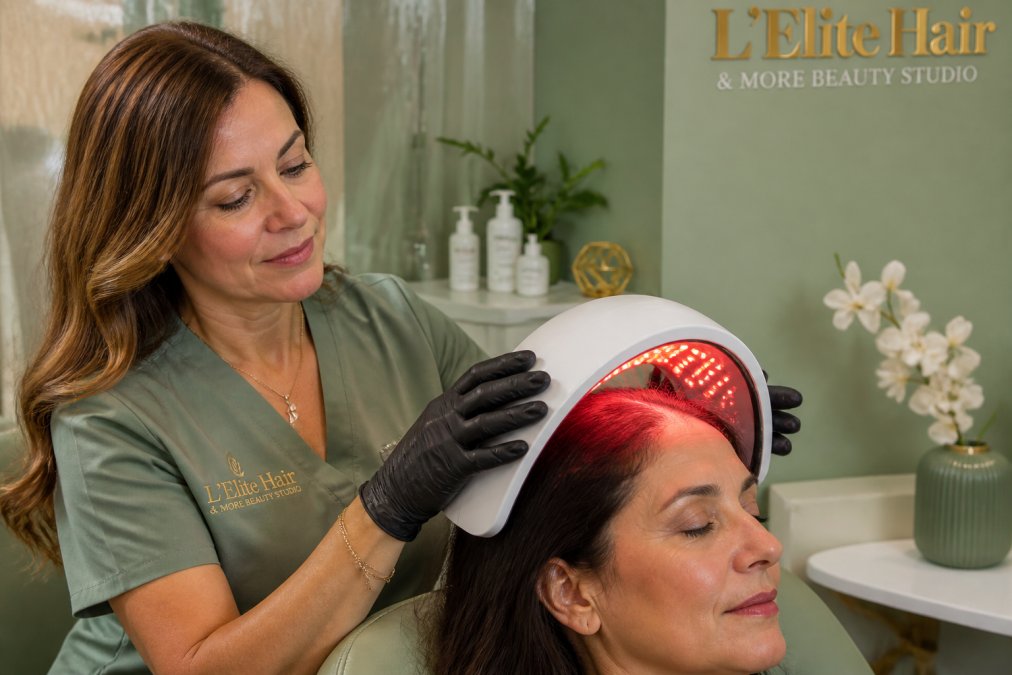
The benefits of LED hair therapy for alopecia come down to one mechanism: light energy that reaches the hair follicle and supports its normal growth activity. This guide from L'Elite Hair & More Beauty Studio explains who tends to respond and how to tell a legitimate device from a decorative one.
How Photobiomodulation Reaches the Hair Follicle
Photobiomodulation works through wavelength, not heat. Red light in the roughly 630-670 nanometer range and near-infrared light around 810-850 nanometers penetrate to different scalp depths. When photons reach the dermal papilla cells at the base of the follicle, they support mitochondrial activity, which affects adenosine triphosphate (ATP) production.
Who May Benefit vs. Who Needs Medical Evaluation
The strongest candidate is someone with androgenetic alopecia (pattern baldness) in its earlier stages, where follicles are miniaturized but still active. People with telogen effluvium, the diffuse shedding that follows stress, illness, or a life transition, may also find it supportive once the trigger is addressed.
LED Light Therapy Frequency for Hair: Finding Your Treatment Rhythm
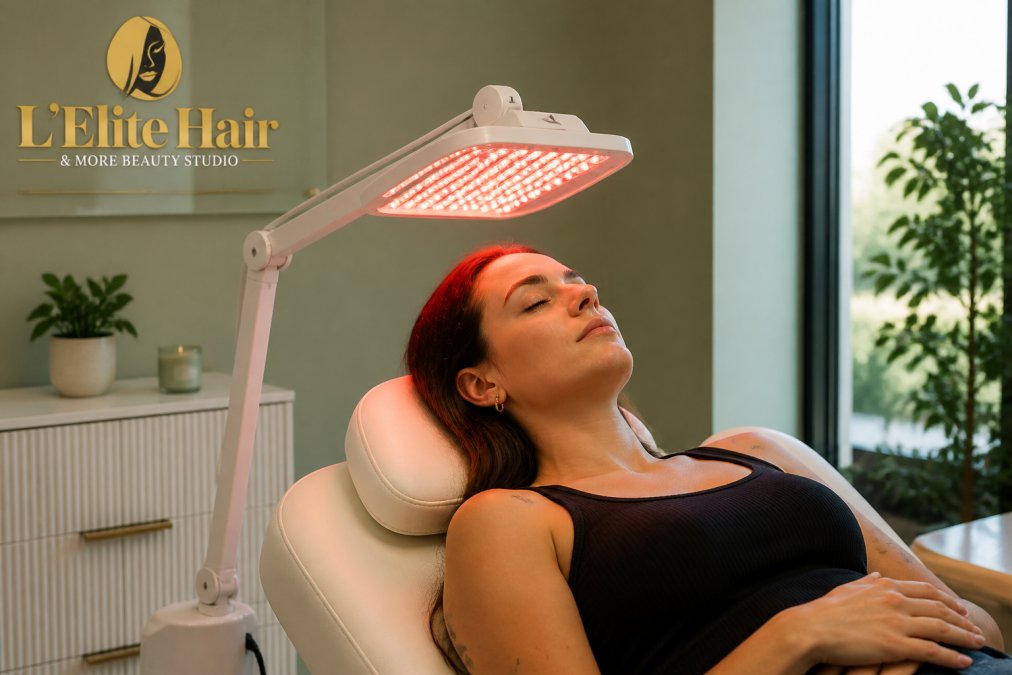
LED light therapy frequency for hair typically means sessions of 15 to 30 minutes, three to five times per week, sustained for at least three to six months before judging results. Consistency outperforms intensity.
| Variable | Common Mistake | Better Approach |
|---|---|---|
| Session length | 45+ minutes "to be safe" | Follow the device's stated protocol |
| Frequency | Daily for a week, then never | 3-5 sessions weekly, steady |
| Duration of trial | Quitting at 4 weeks | Commit to 3-6 months minimum |
| Device placement | Holding it at an angle | Keep the panel flat against the scalp |
| Tracking | Judging by feel | Photograph the same part line monthly |
FDA-Cleared vs. FDA-Registered: What the Label Actually Means
A device marketed as "FDA-registered" is not the same as one that is "FDA-cleared." Registration simply means the manufacturer has told the agency it exists and where it is made; it says nothing about safety or effectiveness for hair growth. A cleared device has gone through a premarket review pathway, typically the 510(k) route, with demonstrated substantial equivalence to a legally marketed predicate device for a specific intended use.
Here is a practical verification framework:
- Search the FDA's establishment registration and device listing database for the manufacturer's name.
- Look for the specific 510(k) clearance number, not just the words "FDA cleared" in marketing copy.
- Read the cleared indication. Some devices are cleared for "androgenetic alopecia" specifically; others are cleared for general "light-based therapy" and the hair claim is marketing, not the cleared use.
- Check whether the wavelength and irradiance on the spec sheet match what the clearance describes.
- Be skeptical of before-and-after photos with no dates, no lighting consistency, and no stated treatment duration.
- Treat any claim of a "cure" as a red flag. Cleared devices support a condition; they do not cure it.
FDA 510(k) premarket notification database
Wavelength, Irradiance, and the Spec Sheet Test
Three numbers on a spec sheet separate a serious device from a decorative one:
- Wavelength. Red light in the roughly 630-670 nanometer range and near-infrared around 810-850 nanometers are the ranges most studied for scalp application. A device that lists only "red light" without a number is not giving you enough information.
- Irradiance. Measured in milliwatts per square centimeter, this tells you how much energy reaches the scalp per unit of time. Higher is not automatically better, the therapeutic window matters, but a device that will not publish the number is usually hiding a low one.
- Treatment time to reach the stated dose. A device that needs 45 minutes to deliver the energy a well-designed unit delivers in 15 is not more powerful; it is less efficient.
What This Means for Your Routine
Once a device passes the verification test, the frequency guidance above applies. If you are unsure whether a device suits your situation, or whether your shedding responds to light therapy at all, start with a professional scalp evaluation. A microscopy scalp analysis at L'Elite Hair & More Beauty Studio gives you a baseline of scalp condition, buildup, and hair density before you commit months to any routine, and a personalized scalp wellness consultation can help you decide whether LED therapy belongs in your plan.
The Microscopy Scalp Analysis Benefits Before You Commit
A microscopy scalp analysis uses a magnified camera to look at the scalp and follicle openings directly. The main benefit is baseline data: you see scalp condition, buildup, redness, and hair density before you spend months on any routine.
How to Improve Scalp Health Naturally Alongside LED Sessions
Learning how to improve scalp health naturally makes LED sessions work harder, because light supports a follicle that already has a clean, well-oxygenated environment. A congested scalp limits what any device can do.
Practical steps that fit alongside LED therapy:
- Wash with a gentle, sulfate-free cleanser and focus on the scalp, not just the strands
- Avoid heavy oils and leave-in products that sit on the scalp for days
- Keep heat styling tools off the scalp and limit high-heat sessions
- Manage tension: tight braids, weaves, and ponytails pull on follicles over time
- Support sleep, protein intake, and stress management, all of which influence the hair cycle
- Book a professional scalp detox periodically rather than relying on home scrubs
Combining LED Hair Therapy With Professional Scalp Care
Combining LED hair therapy with professional scalp care produces better results than either approach alone: LED supports follicle activity, while professional care addresses the scalp environment the follicle lives in.
LED Plus Topical Minoxidil
Minoxidil is a topical vasodilator that extends the anagen phase and is one of the few over-the-counter options with decades of clinical use behind it. LED therapy works through a different mechanism, photobiomodulation at the cellular level, so the two are not competing for the same pathway. A common pattern is to apply minoxidil as directed and use LED sessions at a separate time of day, since minoxidil needs to absorb into a clean, dry scalp and a light panel pressed against the head can interfere.
A few practical notes:
- Space the two apart by at least a few hours when possible.
- Do not apply minoxidil immediately before an LED session.
- Watch for scalp irritation. Minoxidil can cause dryness or flaking in some users, and a compromised scalp barrier makes any topical routine harder to tolerate.
- Tell your stylist or trichologist what you are using. This is not a reason to stop, it is a reason to coordinate.
LED Plus Prescription Oral Treatments
Finasteride and similar prescription options work systemically, not on the scalp surface, so there is no direct interaction with a light panel. These are prescription medications with real side-effect profiles that require a physician's oversight. L'Elite does not prescribe, recommend, or manage prescription hair-loss medications. If you are on one, LED therapy can sit alongside it as a cosmetic scalp-wellness service, but the medical decision belongs to you and your prescribing doctor.
LED Plus PRP or In-Office Procedures
Platelet-rich plasma and similar in-office treatments involve injections or micro-needling into the scalp. General guidance is to let the scalp recover from any procedure that breaks the skin barrier before resuming LED sessions, often a matter of days, but the specific window should come from the provider who performed the procedure. Light therapy on freshly treated skin is not dangerous in any documented way, but it is unnecessary and can be uncomfortable.
LED Plus Professional Scalp Care at the Studio
At L'Elite Hair & More Beauty Studio, the in-studio combination might include a Deep Scalp Detox, customized herbal scalp treatments, and LED hair therapy within one care plan, alongside healthy-hair services like Silk Press or natural hair care that avoid unnecessary tension and heat. Linda E., a licensed cosmetologist and certified trichologist, builds these plans around the microscopy findings rather than a fixed package.
What Not to Combine
- Do not stack multiple at-home light devices on the same scalp area in the same session.
- Do not use LED therapy as a substitute for a prescribed treatment without talking to the prescriber.
- Do not treat LED as a reason to skip medical evaluation for sudden, patchy, or unexplained shedding.
What to Expect: Timeline, Maintenance, and Realistic Goals
Realistic expectations follow a predictable arc. Weeks one through four usually bring nothing visible. Months two and three are when many people notice reduced shedding or less scalp visibility at the part. Months four through six are when hair density and hair shaft thickness changes become easier to see in photos.
Frequently Asked Questions
How long does it take to see results from LED hair therapy for alopecia?
Most people who respond to LED hair therapy notice early changes in shedding and scalp feel within eight to twelve weeks of consistent use. Visible changes in hair density and hair shaft thickness typically take four to six months because the anagen phase, the active growth stage, has to complete a full cycle. Results vary by the type of hair thinning, how consistent you are, and whether you combine sessions with professional scalp care.
Can you overdo LED light therapy for hair growth?
Yes. More sessions do not mean faster results. Overuse can leave the scalp feeling warm, tender, or irritated, and it does not speed up hair follicle stimulation. Most at-home devices recommend three to five sessions per week, while professional in-studio LED hair therapy is usually scheduled weekly or every other week. Stick to the frequency recommended for your device or by your scalp wellness provider.
Is LED hair therapy suitable for all types of hair thinning?
LED hair therapy tends to work best for androgenetic alopecia, also called pattern baldness, and for general thinning where the hair follicle is still active. It is less predictable for scarring alopecia or thinning caused by an untreated medical condition. This is why a microscopy scalp analysis matters: it shows whether follicles are miniaturized, dormant, or scarred, so you know if LED sessions are a reasonable fit or if you should see a dermatologist first.
Can LED therapy be combined with other professional scalp care services?
LED hair therapy pairs well with scalp detox, herbal scalp treatments, Japanese Head Spa, and Indian Head Massage because those services support scalp circulation and a healthy scalp environment. Many providers, including L'Elite Hair & More Beauty Studio in Bonita Springs, build LED sessions into a personalized scalp wellness plan. If you use minoxidil or another prescription treatment, keep your dermatologist informed so the timing of each approach works together.